Every so often somebody notices that a Starship is very large, that it is filled with fossil natural gas, and that SpaceX would like to fly one most weeks, and concludes that the biggest rocket ever built must be a climate problem in proportion to its size. The first two observations are correct. The conclusion does not follow from them, and the distance between the premise and the conclusion is one of the widest in any live argument about emissions.
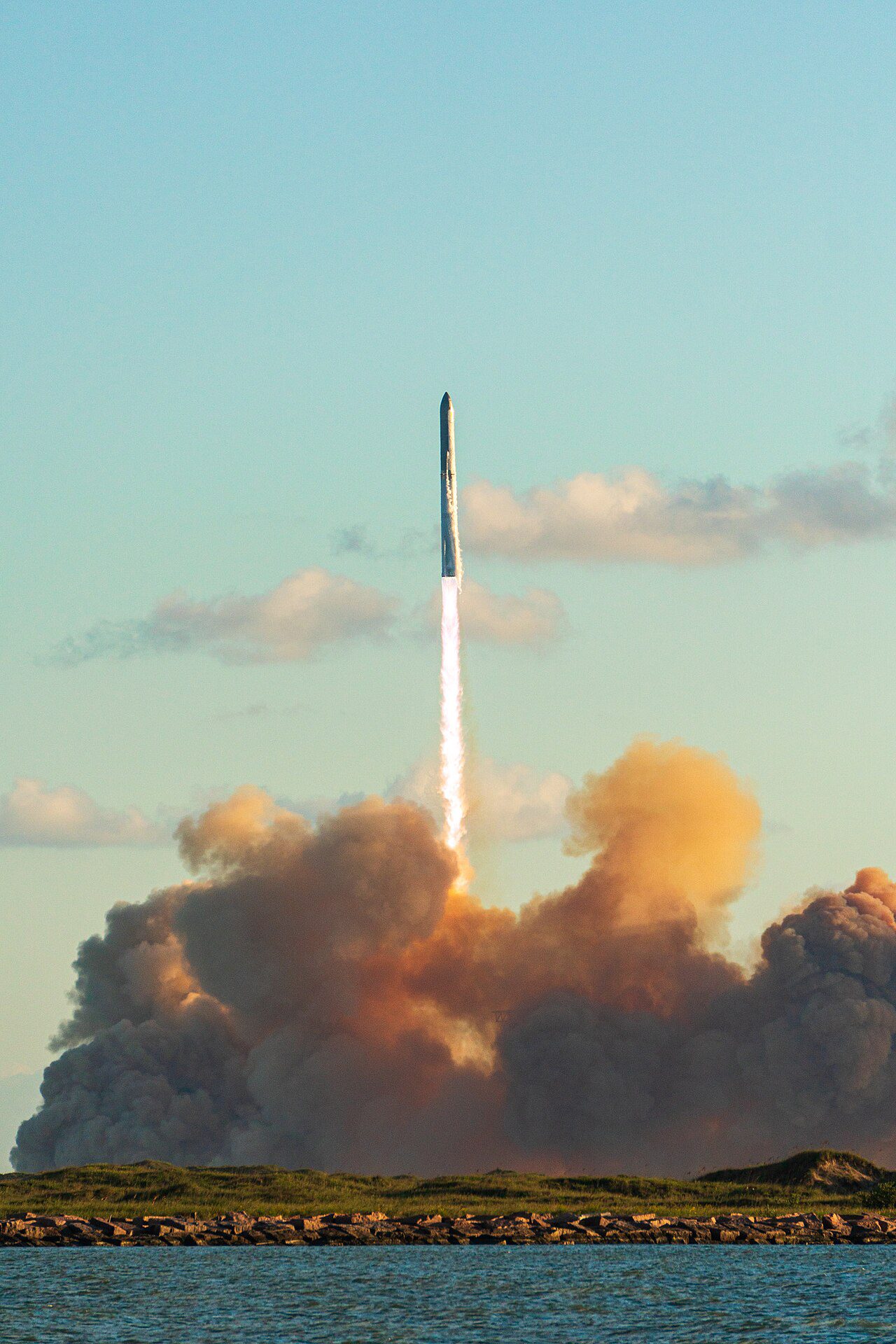

The arithmetic is not a matter of opinion, because SpaceX has had to file it four times in four years. Every American launch site needs an environmental assessment before anybody lights anything, and each one contains a table of estimated greenhouse gas emissions with the agency’s name on it. Those tables are the best public accounting of what a Starship costs the atmosphere, and they are worth reading before forming a view.
The number, and what it is worth
Start at Boca Chica. The Federal Aviation Administration’s 2025 assessment of an increased launch cadence puts the annual emissions from twenty-five Starship and Super Heavy launches at 58,450 metric tons of carbon dioxide equivalent1. That is 2,338 tons a launch — own calculation, dividing the one figure by the other. The British government’s 2026 conversion factors put an average long-haul widebody at 24.0 kg of carbon dioxide per aircraft-kilometre, over an average stage length of 6,799 km2. A London to New York sector, with the standard 8 per cent uplift for the real routing, is about 145 tons. So one Starship launch is worth roughly sixteen full transatlantic flights, one way.
That is the whole of it. Not sixteen thousand flights, not sixteen hundred. Sixteen.
One launch, in units people already have a feel for
Carbon dioxide equivalent, metric tons. Starship figure is the FAA's own annual estimate for 25 launches at Boca Chica divided by 25; flights are a London–New York sector at the UK government's 2026 long-haul fleet-average factor. Own calculations from both.
Now scale it up as far as the paperwork allows. SpaceX holds three authorisations: twenty-five launches a year from Boca Chica, granted by the FAA in April 20251; forty-four a year from Launch Complex 39A at the Kennedy Space Center, granted in a record of decision signed on 29 January 20263; and seventy-six a year from Space Launch Complex 37 at Cape Canaveral, granted by the Department of the Air Force in November 2025, subject to an airspace review4. That is 145 launches a year. Starship has flown a handful of times a year since April 2023 — the FAA counted two flights in 2023, four in 2024 and two by the spring of 20251 — so this is a ceiling nobody is near. Take it anyway, because it is the most hostile case the documents support.
Add the three sites’ own annual totals — 97,342 tons at Boca Chica, 217,355 at Launch Complex 39A and 379,717 at Space Launch Complex 37 — and the entire authorised American Starship programme comes to about 694,000 tons of carbon dioxide equivalent a year134. Global fossil carbon dioxide emissions were 38.1 billion tons in 20255. The programme is 0.0018 per cent of that. Global aviation emitted 1,034 million tons of carbon dioxide in 2018, the most recent year with a proper published accounting6. Spread evenly across the year, that means the world’s aeroplanes emit as much in about six hours as the entire Starship programme does in a year — own calculation, and a generous one, since the Starship figure counts methane as well as carbon dioxide and the aviation figure does not.
The FAA reached the same place in its own words: the increased cadence at Boca Chica “would account for less than 0.0003% of worldwide GHG emissions, approximately 0.002% of US GHG emissions, and approximately 0.012% of the State of Texas GHG emissions, on an annual basis”1.
The world’s aeroplanes emit as much in about six hours as the entire Starship programme does in a year.
— The carbon question
None of this is an argument that rockets are harmless. It is an argument that carbon dioxide is the wrong thing to be counting, and that anybody who opens with it has not looked up the number. The interesting question is not how much carbon a Starship emits. It is what else comes out of the engine, and how methane compares with the alternatives on that score.
What does not come out of a Raptor
Rocket exhaust is a short list of things and the list depends entirely on the propellant. The best current inventory, assembled by Connor Barker and Eloise Marais at University College London with Jonathan McDowell, gives an emission index for each species and each fuel, in grams per kilogram of propellant burned7. Solid rocket motors — the strap-on boosters on the Space Shuttle, on Ariane 6, on the Space Launch System, on Vulcan — emit 328 g of aluminium oxide and 217 g of chlorine compounds for every kilogram they burn. Methane and oxygen emit neither. Not a reduced quantity: none. There is no aluminium in the propellant and no chlorine in the propellant, so there is none in the exhaust.
This matters more than the carbon does, because chlorine is the thing that actually eats ozone. When Laura Revell’s group at the University of Canterbury ran a chemistry-climate model over a plausible 2030 launch fleet last year, they found that “In the ALL simulation, the effects on ozone are mostly due to Cly (from SRM-emitted HCl reacting) and black carbon (emitted from kerosene, SRM and hypergolic propellants)”8. Read that list again: solid motors, kerosene, hypergolics. Methane is not on it.
The scale of the difference is easier to feel per launch than per kilogram. A modelling group at the University of Stuttgart published a launch emissions tool this year that computes a full species inventory for individual flights. An Ariane 6 launch puts on the order of 90 tons of aluminium oxide and 39 tons of hydrogen chloride into the atmosphere9. A Starship launch puts up none of either. If the question is which heavy-lift vehicle to prefer on atmospheric grounds, the answer is not close, and it is the methane one.
The soot question, which is where the honest doubt lives
That leaves black carbon — soot — which is the species the atmospheric literature worries about most, and the one place the case for methane needs care rather than confidence.
Soot from a rocket is not like soot from a lorry. A rocket puts it directly into the stratosphere, where there is no rain to wash it out, and it sits there for years absorbing sunlight. Robert Ryan and colleagues at University College London calculated the warming each tonne of it does, and put rocket black carbon at 7,800 milliwatts per square metre for every teragram emitted, against 20.7 for every other source of soot on Earth — a factor of 37510. A ton of soot from a rocket does what several hundred tons from a chimney would do. If a vehicle makes soot, where it makes it is what counts.
On paper methane is the cleanest hydrocarbon available: 5 g of black carbon per kilogram of propellant, against 22 for kerosene7. SpaceX’s own plume contractor went further. Modelling the Raptor booster engine for the 2022 assessment, Sierra Engineering concluded that “No soot is predicted to be generated by this engine cycle”11. The FAA repeated the point when answering public comments, writing that “Starship and Super Heavy do not emit particles, including soot and alumina, which are the main source for climate and ozone impacts”12.
Here is the caveat, and it is a real one. Per kilogram is not per launch, and a Starship burns 6,750 tons of propellant1, ten times what a Falcon 9 burns9. When the Stuttgart group modelled an actual Starship flight — the eighth test, in March 2025 — and set it beside a Falcon 9, the clean fuel came out behind. Starship: 4,942 kg of black carbon. Falcon 9: 2,658 kg9. Nearly twice as much, from the cleaner chemistry. Efficiency per kilogram loses to the number of kilograms, as it usually does.
Clean fuel, large rocket
Black carbon. Methane is the cleanest hydrocarbon per kilogram of propellant and still emits more per launch than a Falcon 9, because a Starship burns roughly ten times as much. For methane and oxygen, each bar runs to the lower of the two published estimates for methane soot and its extension to the higher; the two differ by a factor of eight.
The numbers in this chart
| Propellant | Black carbon, g per kg of propellant | | --- | --- | | Kerosene and oxygen | 22 | | Solid motor | 16 | | Hypergolic | 16 | | Methane and oxygen | 5 (inventory index), 0.6 (closed-cycle estimate) | | Vehicle | Propellant burned, t | Black carbon per launch, kg | | --- | --- | --- | | Falcon 9 | about a tenth of Starship’s | 2,658 | | Starship | 6,750 | 4,942 at 5 g per kg; about 590 at 0.6 g per kg | The per-kilogram indices are from Barker, Marais and McDowell (2024), table 1, except the closed-cycle methane figure, which is from Callsen and others (2026), table 5, for a staged-combustion engine with fuel film cooling. The per-launch figures are modelled totals to 100 km from Fischer and others (2026), supplement tables S10 and S12; the 590 kg figure is this paper's own calculation, scaling their result by 0.6/5.Before that number is used as a verdict, look at where it comes from. The 5 g per kilogram that makes Starship look sooty has never been measured on a rocket. A team at the German Aerospace Center went looking for its provenance this year and reported that for methane engines “In the absence of rocket-specific empirical measurements, automotive engine exhaust data has frequently been used as a proxy”13. The proxy is a 2016 study of compressed-natural-gas passenger cars in Science of the Total Environment14. The soot index for the largest rocket ever built is an extrapolation from a bi-fuel saloon.
The same paper worked the problem from combustion physics instead, and got a very different answer. Soot forms in fuel-rich pockets, which is what an open-cycle engine’s gas generator produces by design; a closed-cycle engine like Raptor has none. Their finding, in which O/F is the ratio of oxygen to fuel: “As a result, closed-cycle hydrocarbon engines with sufficiently high O/F ratios do not produce BC in the equilibrium exhaust. However, in reality, soot or BC formation is observed even in these engines because the mixture ratio is not homogenous”13. Allowing for the fuel film that cools the chamber wall, they put a closed-cycle methane engine at 0.6 g per kilogram — against 8.0 for the equivalent kerosene engine13. Substitute that index and Starship’s per-launch soot falls from 4,942 kg to about 590, about a fifth of a Falcon 9’s rather than twice it. That is an own calculation, and it is no better founded than the number it replaces.
So the honest position on Starship soot spans a factor of eight, and nobody has ever put an instrument in a Raptor plume. The figure that makes the vehicle look bad and the figure that makes it look excellent are both extrapolations. That is an argument for measuring it, which would cost a rounding error against a single test flight, and not an argument for assuming the worse end.
Water, which sounds bad and is not
Methane’s other distinction is that it is the wettest hydrocarbon in the business: 446 g of water per kilogram of propellant against kerosene’s 3407. A Starship launch injects something like 1,340 to 1,394 tons of water vapour, around thirteen times a Falcon 99. Water vapour is a greenhouse gas, the stratosphere is very dry, and this sounds like it should be the catch.
It is not, and this is the part where the modelling is unusually clean. Revell’s group put 104.82 Gg of rocket water a year into the stratosphere in their busiest scenario and reported that “changes in the concentrations of rocket-emitted water vapour and NOx are small (less than 2% and 4%, respectively) and statistically insignificant compared with stratospheric background concentrations”8. That scenario is not a small one next to Starship: twenty-five launches a year would contribute about a third as much water, and the full 145-launch authorisation about twice as much — own calculations, from the Stuttgart per-launch figures. The reassurance is therefore for a number the ceiling would exceed, which is worth saying plainly. Ryan’s group found the water’s radiative effect was not merely small but negative, at −0.20 mW m⁻², because it encourages the formation of reflective polar stratospheric clouds10. The stratosphere is large and rockets are small, and on this species the comparison is not close either.
While we are being even-handed about the models: they do not agree on whether rocket soot warms the surface. Ryan’s instantaneous calculation gives a positive forcing. Christopher Maloney and colleagues at NOAA ran a fully coupled model with stratospheric adjustment and found the top-of-atmosphere flux change statistically indistinguishable from zero and the surface very slightly cooler — −0.0071 K in their ten-fold emissions case15. Both results are in the literature. The stratosphere warms in every model; what that does at the ground is genuinely unsettled.
Four things that are actually wrong
None of the above is a clean bill of health, and the problems are worth naming precisely, because they are specific and cheap and they are not the fuel.
The second-largest line in the ledger is methane that never burns. SpaceX’s own estimate, in the 2022 assessment, is that “approximately 7 metric tons of LCH4 would be released to the atmosphere during Starship fuel loading for an orbital launch of the integrated launch vehicle”16. Residual propellant is vented after landing too — up to 101 tons left aboard a Starship and 74 aboard a Super Heavy1. The FAA’s own line for methane venting comes to 35,051 tons of carbon dioxide equivalent a year at Boca Chica, against 58,450 for the launches themselves: thirty-six per cent of the site’s whole greenhouse gas inventory, from fuel that is thrown away rather than used1. In the 2022 version, venting was the single biggest line, larger than the launches16. And the FAA counts it at a global warming potential of 2816, where the IPCC’s Sixth Assessment gives fossil methane 29.8 over a hundred years and 82.5 over twenty17. On the twenty-year figure the vented methane comes to roughly 103,000 tons of carbon dioxide equivalent — own calculation — and outweighs everything the engines do. Burning the methane is the clean part. Spilling it is not.
The gas has to get there, and nobody counts that either. Measured across nearly a million aerial observations, the American oil and gas supply chain leaks about 2.43 per cent of the gas it produces — a figure revised down from 2.95 in a 2026 correction to the original paper18. An earlier facility-based assessment put it at 2.3 per cent and drew the conclusion that matters here: methane escaping the supply chain “results in roughly the same radiative forcing as does the CO2 from combustion of natural gas over a 20-year time horizon”19. A full Starship stack holds about 1,467 tons of methane — own calculation, from the FAA’s 6,750-ton propellant load and Raptor’s stated 3.6:1 oxygen-to-methane ratio1. Getting that to the pad leaks something like 36 tons on the way, worth about 3,000 tons of carbon dioxide equivalent on a twenty-year basis — own calculation again, from the leakage rate and the IPCC’s figure. That is more than the launch itself, and it appears in no filing.
The fuel is fossil by design, and is meant to stay that way. On 13 December 2021 Elon Musk announced that “SpaceX is starting a program to take CO2 out of atmosphere & turn it into rocket fuel. Please join if interested”20. Six months later the FAA, answering comments on the Boca Chica assessment, recorded the company’s position: “SpaceX remains committed to exploring new technologies for reducing GHG emissions and recycling liquid methane as technology and design progress. However, none are feasible at this time”12. Four years on, the words carbon neutral, Sabatier, synthetic methane and direct air capture do not appear anywhere in the four federal environmental documents covering the three launch sites. What does appear is a pipeline: the Kennedy Space Center statement records that “In the future, natural gas would be supplied to LC-39A through a multiuser pipeline extending from the existing natural gas main line on KSC. Florida City Gas is in the process of planning an underground pipeline extension at KSC”3. Whatever Starship is, it is not carbon neutral, and no document filed by anyone who has to sign their name says it is.
The fuel plant is missing from the emissions inventory. Both Florida sites plan a methane liquefier and an air separation unit on the pad. Both exclude them from the inventory. The Kennedy statement is explicit: “The liquefaction plant, including the methane liquefier and ASU, is an integral part of the Proposed Action but remains under design. GHG emissions associated with the plant would be dependent on its final design, operational processes, and energy sources”3. The Air Force said the same of Cape Canaveral4. An air separation unit of 222,071 square feet is not a small consumer of electricity, and the step that turns pipeline gas into rocket propellant is currently accounted for at zero.
There is a fifth thing, which is not wrong so much as unknown. Starship is designed to come back intact from orbital velocity, and re-entry heating makes nitrogen oxides out of ordinary air. Ryan’s group found re-entry, not launch, was the largest single contributor to rocket-driven ozone loss10. Revell’s group left re-entry out altogether and said so, noting that it “is important to consider in future work”8. A fleet of large, reusable, orbital-velocity vehicles returning weekly is precisely the case nobody has modelled. Against that, Ryan’s own bound is reassuring: re-entry heating from reusable stages would need “annual launches of reusable rockets” to “reach 100,000” before global stratospheric ozone fell half a per cent10. One hundred thousand is not 145.
The regulator’s own arithmetic
Not everything wrong here is a defect in the vehicle. At Launch Complex 39A the FAA’s own analysis found that the programme’s emissions “exceeds insignificance indicator threshold by approximately 319 percent” and that “the FAA anticipates that GHG emissions from operations would be considered potentially significant”3. It approved the launches anyway — which is defensible, given every number above. But the agency also notes elsewhere that it “has not set a significance threshold for climate”1. A regulator that finds an effect significant against a threshold it says does not exist, and approves it, is not really regulating. It happens to have reached the right answer here. That is not the same as having a method.
The verdict
On the question as usually asked — is the fuel a problem? — the answer is no, and it is not a close call. Methane and oxygen is the best propellant chemistry anyone currently flies. It emits no chlorine and no aluminium oxide, which are the two species that do most of the damage to ozone. Its water, at every rate anyone has modelled, does nothing that rises above the noise. And its carbon dioxide, at the full authorised cadence of every American launch site, is a morning of world aviation. A reader looking for hydrocarbons burned in the sky to worry about will get more for the worry from the aeroplanes.
What is true is narrower and less satisfying than either side usually wants. Climate neutral is not a property Starship has, because its methane comes out of the ground and is planned to keep coming out of the ground through a pipeline that a Florida utility is currently designing. But making the methane synthetic would fix the smallest column in the ledger. The carbon was never the expensive part.
The things worth doing are unglamorous and cheap. Put an instrument in a Raptor plume, so that the soot index for the world’s largest rocket stops being an extrapolation from a compressed-natural-gas car. Capture the seven tons vented at every fuel load, part of what is currently the second-largest line in SpaceX’s own greenhouse gas accounts. Count the liquefier. None of these costs a fraction of a test flight, and all three would replace an argument with a measurement.
Sources
-
Federal Aviation Administration, “Final Tiered Environmental Assessment for SpaceX Starship/Super Heavy Vehicle Increased Cadence at the SpaceX Boca Chica Launch Site in Cameron County, Texas”, April 2025. Table 4, p. 21 (greenhouse gases); table 2, p. 9 (propellant capacity 2,650 t Starship, 4,100 t Super Heavy); p. 13 (residual propellant); p. 22 (share of worldwide emissions, significance threshold); footnote 17, p. 62 (Raptor mixture ratio 3.6:1). ↩︎ ↩︎ ↩︎ ↩︎ ↩︎ ↩︎ ↩︎ ↩︎ ↩︎ ↩︎
-
Department for Energy Security and Net Zero, “Greenhouse gas reporting: conversion factors 2026”, 2026. Methodology report, table 35 (long-haul average 24.0 kg CO2 per aircraft-km, 316 seats, 6,799 km average stage length) and table 34 (London–New York 5,600 km, before the 8 per cent great-circle uplift). ↩︎
-
Federal Aviation Administration, with NASA and the United States Space Force, “Environmental Impact Statement for the SpaceX Starship-Super Heavy Launch Vehicle at Launch Complex 39A at the Kennedy Space Center, Merritt Island, Florida”, final, volume I, January 2026. Table 3.12-3, p. 3-234 (217,354.74 t CO2e annual total); p. 3-236 (319 per cent, potentially significant); p. 3-233 (liquefaction plant excluded); p. 2-25 and ES-22 (natural gas pipeline). Record of decision signed 29 January 2026. ↩︎ ↩︎ ↩︎ ↩︎ ↩︎
-
Department of the Air Force, “SpaceX Starship-Super Heavy Cape Canaveral Space Force Station Final Environmental Impact Statement”, November 2025. Table 3.1-6, p. 3-7 (379,717 metric tons CO2e a year); p. 3-6 (liquefier and air separation unit not yet designed, emissions excluded). Record of decision signed 20 November 2025, authorising up to 76 launches a year subject to an FAA airspace analysis. ↩︎ ↩︎ ↩︎
-
Pierre Friedlingstein and others, “Global Carbon Budget 2025”, Earth System Science Data 18, 3211–3288, 2026, doi:10.5194/essd-18-3211-2026. Executive summary: fossil emissions of 10.4 GtC, or 38.1 GtCO2, projected for 2025. ↩︎
-
David S. Lee and others, “The contribution of global aviation to anthropogenic climate forcing for 2000 to 2018”, Atmospheric Environment 244, 117834, January 2021. Abstract: aviation CO2 emissions of 1,034 Tg in 2018, and non-CO2 terms accounting for 66 per cent of aviation’s net effective radiative forcing. ↩︎
-
Connor R. Barker, Eloise A. Marais and Jonathan C. McDowell, “Global 3D rocket launch and re-entry air pollutant and CO2 emissions at the onset of the megaconstellation era”, Scientific Data 11, 1079, October 2024. Table 1, emission indices in grams per kilogram of propellant: methane 5 black carbon and 446 water; kerosene 22 and 340; solid 16 black carbon, 328 aluminium oxide, 217 chlorine compounds. ↩︎ ↩︎ ↩︎
-
Laura E. Revell and others, “Near-future rocket launches could slow ozone recovery”, npj Climate and Atmospheric Science 8, 212, June 2025. Table 1 (104.82 Gg stratospheric water a year in the ambitious growth scenario); attribution of ozone loss to chlorine and black carbon; water vapour and nitrogen oxide perturbations statistically insignificant; re-entry material excluded. ↩︎ ↩︎ ↩︎
-
Jan-Steffen Fischer, Stefanos Fasoulas, Marius Nützel and Alexander Schmidt, “Launch Emission Assessment Tool (LEAT v1.0): Part I — Development of a tool to calculate altitude-dependent rocket launch emissions for use in chemistry-climate models”, EGUsphere preprint, discussion started 30 June 2026. Not yet peer-reviewed. Supplement tables S10, S12 and S14, total emissions to 100 km: Starship flight 8, black carbon 4,942 kg and water 1,340,479–1,394,015 kg; Falcon 9, black carbon 2,658 kg; Ariane 6, aluminium oxide 90,462 kg and hydrogen chloride 38,685 kg. ↩︎ ↩︎ ↩︎ ↩︎
-
Robert G. Ryan, Eloise A. Marais, Chloe J. Balhatchet and Sebastian D. Eastham, “Impact of Rocket Launch and Space Debris Air Pollutant Emissions on Stratospheric Ozone and Global Climate”, Earth’s Future 10(6), e2021EF002612, June 2022. Section 3.2 for the black carbon forcing efficiency and the polar stratospheric cloud term; section 3.3 for re-entry nitrogen oxides as the largest ozone-depleting contribution and the 100,000-launch bound from Larson and others (2017). ↩︎ ↩︎ ↩︎ ↩︎
-
Sierra Engineering and Software, “Exhaust Plume Calculations”, analysis report 2022-001P on the SpaceX Raptor booster engine, prepared for SpaceX, 31 May 2022, published as appendix G to the FAA’s final programmatic environmental assessment. Summary, p. 1; nozzle-exit species mass fractions, table 3, p. 5. ↩︎
-
Federal Aviation Administration, “Appendix I: Responses to Public Comments”, final programmatic environmental assessment for the SpaceX Starship/Super Heavy launch vehicle program at Boca Chica, June 2022, pp. I-9 to I-10. ↩︎ ↩︎
-
Steffen Callsen, Moritz Herberhold, Jascha Wilken and Martin Sippel, “Reference datasets of primary rocket engine emissions for global launch inventories”, CEAS Space Journal, September 2026. Table 3 (equilibrium exhaust, closed-cycle engines) and table 5 (with fuel film cooling: 0.6 g black carbon per kg for a closed-cycle methane engine, 8.0 for the kerosene equivalent); section on the provenance of black carbon emission indices. ↩︎ ↩︎ ↩︎
-
Yang Wang, Zhenyu Xing, Hui Xu and Ke Du, “Emission factors of air pollutants from CNG-gasoline bi-fuel vehicles: Part I. Black carbon”, Science of The Total Environment 572, 1161–1165, December 2016. The study from which the 80 per cent reduction, and hence the 5 g per kg rocket figure, is extrapolated. ↩︎
-
Christopher M. Maloney, Robert W. Portmann, Martin N. Ross and Karen H. Rosenlof, “The Climate and Ozone Impacts of Black Carbon Emissions From Global Rocket Launches”, Journal of Geophysical Research: Atmospheres 127(12), e2021JD036373, June 2022. Table 1: for the 10 Gg per year case, stratospheric temperature +0.16 K, surface temperature −0.0071 K, column ozone −3.5 DU, top-of-atmosphere net flux within model variability. ↩︎
-
Federal Aviation Administration, “Final Programmatic Environmental Assessment for the SpaceX Starship/Super Heavy Launch Vehicle Program at the Boca Chica Launch Site in Cameron County, Texas”, June 2022. P. 20 (7 metric tons of liquid methane released during fuel loading); pp. 51–52 (global warming potential of 28 for methane); table 3-3, pp. 53–54 (methane venting 23,000 of 43,892 metric tons CO2e). ↩︎ ↩︎ ↩︎
-
Piers Forster, Trude Storelvmo, Kyle Armour and others, “The Earth’s Energy Budget, Climate Feedbacks and Climate Sensitivity”, chapter 7 of Climate Change 2021: The Physical Science Basis, Working Group I contribution to the Sixth Assessment Report of the Intergovernmental Panel on Climate Change, Cambridge University Press, 2021, table 7.15, p. 1017. Fossil methane: 82.5 ± 25.8 over 20 years, 29.8 ± 11 over 100. ↩︎
-
Evan D. Sherwin and others, “US oil and gas system emissions from nearly one million aerial site measurements”, Nature 627, 328–334, 13 March 2024. Six-region weighted average of 2.43 per cent of covered natural gas production, as revised by the author correction of 29 May 2026 (doi:10.1038/s41586-026-10605-5) from the 2.95 per cent originally published. ↩︎
-
Ramón A. Alvarez and others, “Assessment of methane emissions from the U.S. oil and gas supply chain”, Science 361(6398), 186–188, 13 July 2018. Supply chain emissions of 13 ± 2 Tg a year, or 2.3 per cent (+0.4/−0.3) of gross US gas production. ↩︎
-
Elon Musk, post on X, 13 December 2021, 22:21 UTC. Retrieved 24 September 2026 and verified against the account’s numeric identifier rather than its display name. ↩︎