The EU banned plastic drinking straws in 2021. Has the world become cleaner since? And are the alternatives perhaps worse than what was banned?
By Raphael Bauer37 min read
In May 2026 Capri-Sun stopped collecting signatures. The drinks maker from Eppelheim in Baden-Württemberg had turned to the public in August 2024 to win back a plastic straw for its pouches, which have come with a paper one since the …
Germany, France and, up to a point, the United States brought in quotas to raise the share of women in leadership. Did they work?
By Raphael Bauer30 min read
Four of the 40 companies in Germany’s DAX are run by a woman. Four of the 40 in France’s CAC 40. In the United States, 48 of the 500 in the S&P 500. Three countries, three different approaches to the question, and much the …
A record 288,579 Germans emigrated in 2025, three quarters of them graduates, and the country is losing its best people: so runs the claim. Nearly half of that record went to a destination the statistical office lists as unknown, and its own notes say many of those people never left Germany. What remains is real and about half the size. By the standards of its neighbours and of its own past few Germans leave, and far more graduates from abroad live in Germany than German graduates live abroad. Two things survive the check: the net loss of citizens is the largest since 2008, and no statistic records who is leaving.
By Raphael Bauer45 min read
On 1 June 2026 the Federal Statistical Office published Germany’s migration figures for 2025. On its count more Germans left the country than came back, for the twenty-first year running, and the loss had grown from 81,000 to 97,000. …
In 2004 Germany's environment minister said the renewables programme cost a household about a euro a month, as much as a scoop of ice cream. Twenty-two years and about €320 billion of subsidy later, Germany has the second-highest household electricity price in the European Union and electricity that carries ten times as much carbon as France's. The build-out is real. The bargain was not, and the environment has little to show for it.
By Raphael Bauer30 min read
On 30 July 2004, two days before the reformed Renewable Energy Sources Act (the EEG) came into force, the federal environment minister, Jürgen Trittin, gave Germans a number to hold on to. Es bleibt dabei, his ministry quoted him, it …
Germany has a word for the death of its insects, a law against it and a famous number: three-quarters gone in 27 years. The number is the weight of insects caught at 63 sites in protected areas, 57 of them in one federal state and 37 of them trapped in one year only. Where it was measured, the fall holds up. Nobody had measured the country as a whole when the number appeared in 2017, and nobody has since.
By Raphael Bauer37 min read
In October 2017 the Entomological Society Krefeld, on the Lower Rhine, and a group of ecologists from Nijmegen published what the society’s insect traps had caught over 27 years. The answer was less and less: by 2016 the weight of …
Germany's governments promise business less bureaucracy. On 1 October Potsdam began taxing coffee cups, pizza boxes and forks. The statute is three pages long; the city's guide to applying it has eighteen sections, three other cities read the same tax differently, and Potsdam did not check how much of its rubbish is take-away packaging. The one study with a control group found the bins no lighter.
By Raphael Bauer36 min read
In Potsdam the length of a disposable fork is now a tax question. Since Thursday the city has charged 20 cents on every piece or set of disposable cutlery handed out with food. Section 2 of its official guide says the charge applies to …
In December 1989 the SED voted down a motion to dissolve itself, and the commission that later audited its money recorded a deciding reason: its property. Every renaming since has left the legal person intact, so the claim that Die Linke is legally identical with the SED rests on the German state’s own findings. That identity makes the party answerable for a balance sheet, which it has already settled. It does not make it guilty of the deaths at the Wall, and the reason is German criminal law.
By Raphael Bauer37 min read
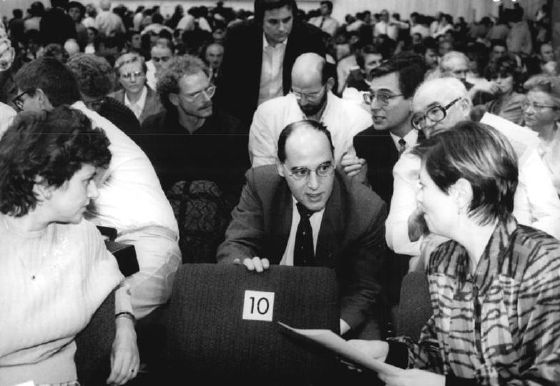
On 8 December 1989 the Sozialistische Einheitspartei Deutschlands (SED), the party that had ruled East Germany for forty years, opened an extraordinary congress in an East Berlin sports hall. At the end of the debate a delegate from a …
Berlin froze its rents in 2020, and in the weeks that followed the number of flats advertised fell by more than half. Catalonia capped its rents the same year, and researchers found no sign that supply shrank. Stockholm has held rents down since the war, and the average wait for a flat there is now nine years. The evidence says rent control works as designed, for the people it was designed for, and sends the bill to everyone who has not arrived yet.
By Raphael Bauer36 min read
The average tenant who got the keys to a rent-controlled flat in Stockholm last year had waited nine years for it. For a flat in the inner city the wait was twenty-one years. Nobody set out to build that. Sweden set out to build a system in …