On 8 December 1989 the Sozialistische Einheitspartei Deutschlands (SED), the party that had ruled East Germany for forty years, opened an extraordinary congress in an East Berlin sports hall. At the end of the debate a delegate from a farm-machinery combine in Erfurt stood up and moved that the party dissolve itself. He said he was acting on instructions from the members who had sent him, and he asked for a vote. When the vote came, not a hand went up for it. According to Günter Benser, a delegate who later wrote up the congress for the party’s own historical commission, both the jubilation and the relief were considerable1.
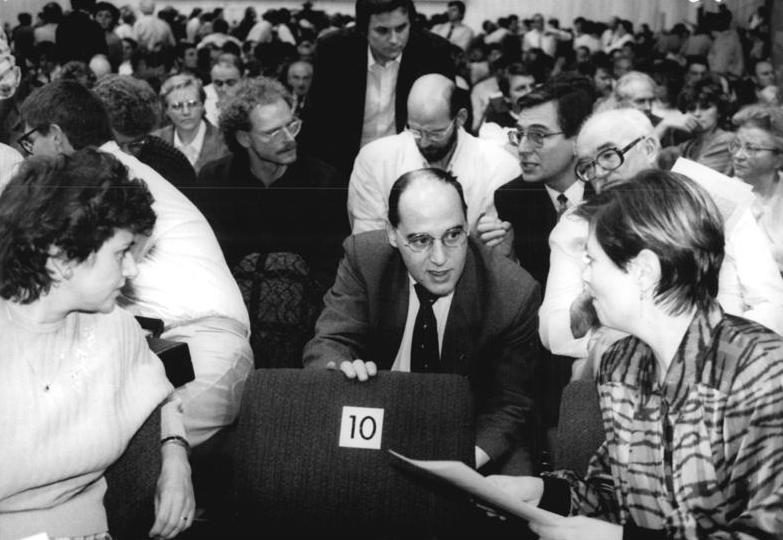
Because the SED did not dissolve, it never had to be founded again, and in law a party that is never re-founded stays the same party. Within two months it had been renamed twice and was called the PDS, the Party of Democratic Socialism2. In 2005 it became Die Linkspartei.PDS, and since 2007 it has been Die Linke3. At no point did one legal person end and another begin.
So someone who says Die Linke is rechtsidentisch with the SED, legally identical to it, is not name-calling. The claim rests on what the Constitutional Court, the Bundestag’s research services and an independent commission that reported to the Bundestag have put in writing. The question is what that identity carries, and above all whether it makes today’s party guilty of the deaths at the Berlin Wall. The answer is clear-cut: it carries a balance sheet, but not a crime.
The claim, conceded in full
The strongest version of the claim is stronger than its opponents admit.
In 2023 a member of the Bundestag asked its research services how party mergers work, with Die Linke as the example. Their papers do not speak for parliament, but this one traces the chain. The 2007 fusion with the WASG, a left-wing party from western Germany, was a Verschmelzung durch Aufnahme, a merger by absorption, in which the Linkspartei.PDS absorbed the WASG. It follows, in the paper’s own words, that “[j]edenfalls zivilrechtlich ist damit die Linkspartei.PDS mit der heutigen Partei DIE LINKE. identisch”: in civil law at least, the Linkspartei.PDS and today’s Die Linke are one and the same. The Linkspartei.PDS in turn, it goes on, came out of the SED, which added PDS to its name in 1989, became the PDS in 1990 and the Linkspartei.PDS in 2005. A change of name affects legal identity no more than a switch between a registered and an unregistered association does. The paper also records a dissenting scholar, for whom the merged party of 2007 is in constitutional terms a new one3.
The blunter version is older. In 1998 the Unabhängige Kommission set up to audit the assets of the GDR’s parties reported to the Bundestag that, because the party had never been re-founded and its members had simply stayed members, the PDS was not merely the SED’s legal successor but the same party. The commission put it in seven words: “Sie ist die in PDS umbenannte SED” (it is the SED, renamed PDS)2.
The Constitutional Court used the same grammar. When the PDS went to the Federal Constitutional Court in 1991 to challenge the freezing of its property, the court wrote of assets “die sie als Sozialistische Einheitspartei Deutschlands (SED) erlangt hatte”, which it had acquired as the SED, and added that in the GDR it had held the position of a state party4. It is all in the pronoun. The applicant standing before the court and the party that built the Wall are one grammatical subject.
Nor has the address changed since. Kleine Alexanderstraße 28 in Berlin, the Karl-Liebknecht-Haus, which the PDS gave as its address in that 1991 case42, is the address Die Linke has on file with the Federal Returning Officer today5.
The applicant standing before the court and the party that built the Wall are one grammatical subject.
Why they kept it
More telling than the party’s survival is why it wanted to survive.
The asset commission’s account is unsentimental. The group around Hans Modrow, Gregor Gysi and Markus Wolf came to the December congress with two aims, “die Auflösung der Partei zu verhindern und eine neue Führung zu wählen” (to prevent the party’s dissolution and to elect a new leadership), and achieved both. At that congress, the commission records, the property played a determining part in the question of saving the party, apparently for the first time. Gysi, who was elected chairman the next morning with about 95% of the votes, told the hall that dissolving and re-founding the party would be a catastrophe: “Das Eigentum der Partei wäre zunächst herrenlos” (the party’s property would at first be ownerless), and several new parties would then be founded and end up fighting in court over the succession2.
In mid-December the party commissioned opinions on what a change of name would do to its property. Their upshot, as the commission records it, was what the party needed: a renaming changes nothing about a party’s existence or its continuation as a legal person, as long as it does not dissolve or constitute itself anew2.
Critics are right that the continuity was real and deliberate, and that a deciding motive was money. It was not the only one. Benser, the delegate, objects that reducing the decision to property and the jobs of the party’s staff ignores what was at stake for the German left as a whole1. Either way, the continuity meant that the party itself had to answer for the money.
What identity carried
Legal identity makes no metaphysical claim about a party’s soul; it is a rule about who owes what. In this case the rule was enforced against the party, and thoroughly.
Because the PDS was the SED, it kept the SED’s debts along with its buildings. In October 1989 the SED had employed around 44,000 full-time staff. By the end of June 1990 the PDS had paid those who left the equivalent of 41 million Deutschmarks in bridging money, and in the second half of that year it paid a further 67 million in severance, under a plan the asset commission called unusually generous2. The Constitutional Court’s 1991 decision treats that payroll as the PDS’s own liability. It records the government’s assurance that the party could draw on the frozen assets for the wages, salaries and severance of staff it had taken over from the SED, even where there were more of them than a party of its size could justify, so that these debts would not swallow the income it needed for ordinary party work4.
Then it lost the rest. The commission’s final report describes a party whose cooperation was hesitant and tactical from the start, and which “verfolgte eine Strategie der Vermögensverschleierung”: it pursued a strategy of concealing its assets6. The PDS had never separated the cash it held on 7 October 1989 from the dues and donations that came in afterwards, and it had always spent far more than those brought in, so none of its money counted as properly acquired. On 31 August 1991 the Treuhandanstalt, the trustee, had everything in the party’s accounts moved to its own: 205.7 million Deutschmarks. From 1 September the party had to operate on new money alone6. The PDS went to court against almost every one of the trustee’s orders. The dispute ended in a settlement at the Berlin higher administrative court on 18 July 1995, under which “[d]ie PDS nahm alle Klagen und Restitutionsanträge zurück und verzichtete unwiderruflich auf ihr gesamtes Altvermögen”: it withdrew every claim and irrevocably renounced all its old wealth. In return, “[d]ie PDS ihrerseits erhielt vier Grundstücke zurück”: the PDS got four properties back, two of which had belonged to the Communist Party (KPD) before 19336. One of the four is the Karl-Liebknecht-Haus, which had been the KPD’s headquarters2.
Counting seized assets, sales, repaid loans and interest, about €1.17 billion had been secured from the party’s assets by the end of 20056.
The PDS was not the only party left with GDR-era party property. The western CDU and FDP took over the GDR’s bloc parties, the smaller parties that sat in its parliament and government without any influence of their own. The DBD joined the CDU der DDR in August and September 1990, and the CDU der DDR merged with the West German CDU on 1 and 2 October 1990. The LDPD and NDPD, by then combined in the Bund Freier Demokraten, joined the FDP in August 1990, and the FDP took over their money and property6. The parallel is one of inheritance, not identity. The PDS is the SED under another name, whereas the eastern CDU’s state associations joined a party that already existed. The commission calls the western CDU and FDP the legal successors of the bloc parties, although it found the FDP’s merger void on formal grounds and let it keep only part of the assets. Today’s CDU is the heir of a party that sat in the GDR’s government and parliament, not that party itself6.
There are two more differences. Of all the organisations it examined, the commission found, “hatte die PDS mit Abstand das umfangreichste Vermögen”: the PDS had by far the largest assets6. And on 15 November 1990 the CDU irrevocably renounced all of the CDU der DDR’s old wealth that the trustee held, keeping only the eastern party’s cash6. That was more than four and a half years before the PDS did the same, in a settlement that ended its lawsuits.
The dead
That leaves the deaths at the Wall, the part most people care about.
Between 1961 and 1989 at least 140 people were killed at the Berlin Wall or died in direct connection with the border regime. The figure comes from a joint project of the Zentrum für Zeithistorische Forschung in Potsdam and the Stiftung Berliner Mauer, which examined 576 deaths and suspected deaths and published a biography of each of the 14078. It sorts them into five groups. The fifth is the GDR’s own border soldiers: eight of the 140, killed on duty by deserters, by comrades, by a refugee, by an escape helper and by a West Berlin policeman87.
Other tallies exist, and the differences between them come down to two questions: who counts as a victim, and what counts as evidence. Prosecutors and police counted only deaths caused by an act of violence. The 140 also include people who drowned, fell or took their own lives while trying to get across97.
Six counts of the dead at the Wall
People who died at the Berlin Wall between 1961 and 1989, as counted by each body. Only the ZZF / Stiftung Berliner Mauer count documents every death with a published biography. The prosecutors and the police task force published no names, and the Arbeitsgemeinschaft 13. August has never disclosed the sources of its lists.
The numbers
| Counted by | Dead at the Berlin Wall | Evidence |
|---|---|---|
| Zentrale Erfassungsstelle der Landesjustizverwaltungen, Salzgitter | 78 | its 1991 report; deaths by shooting and mines only |
| Staatsanwaltschaft Berlin | 86 | only deaths proven to result from an act of violence; no names published |
| Der Polizeipräsident in Berlin | 92 | police count |
| ZERV, the police task force on government crime | 122 | suspected crimes only, no accidents; no names published |
| ZZF Potsdam and Stiftung Berliner Mauer | 140 | 576 cases examined; a published biography for each of the 140 |
| Arbeitsgemeinschaft 13. August | more than 200 | lists of names published; their sources never disclosed |
Hold on to the number that comes with 140 published biographies, even though it is not the largest. A count that documents every death, with a biography and its sources, is a different kind of thing from one that does not, and this paper’s rule is to show that difference rather than average it away.
Beyond Berlin the picture widens. The Forschungsverbund SED-Staat at the Freie Universität Berlin attributed 327 deaths on the inner-German border between 1949 and 1989 to the border regime, a figure that includes 24 guards killed on duty and 44 suicides of border personnel10. Those categories are contested, and Gerhard Sälter of the Stiftung Berliner Mauer has argued in print that up to a hundred of the listed deaths might not survive a close check11. An archived page of the federal government gives at least 140 at the Wall and at least 260 on the inner-German border, with a footnote saying that higher figures quoted elsewhere rest on scientifically contested categories or uncertain sources12. The Stiftung Berliner Mauer uses about 650 for the border regime as a whole, a figure that also counts those who died in the Baltic13.
That the shootings were policy, and not accident, is not in doubt. The Constitutional Court’s 1996 decision on the border shootings sets out the documents. A decision of the National Defence Council of 14 September 1962 required that border violators “in jedem Fall als Gegner gestellt, wenn notwendig, vernichtet werden müssen”: they were to be confronted as enemies in every case and, if necessary, destroyed. The order read out to each platoon before it went on duty told it to allow no breaches of the border and to arrest border violators “oder zu vernichten”, or destroy them. At a session of the National Defence Council on 3 May 1974, Erich Honecker said that firearms must continue to be used ruthlessly against attempted breaches, and that comrades who had used them successfully were to be commended1415.
The Berlin Regional Court, whose findings the Constitutional Court reproduces, also found that no formal, written order to shoot ever existed. That changed nothing, it held, because border soldiers were told orally that a refugee’s death was to be accepted if that was what it took to prevent a breach, and because the practice deliberately went beyond the text of the laws and the written orders14.
The end came down the same chain of command. On 3 April 1989, seven months before the Wall opened, Fritz Streletz, standing in for the defence minister, passed on the party leader’s displeasure at recent incidents on the border to the commanders of the border troops. Their note of the meeting records the new rule in one line: “Lieber einen Menschen abhauen lassen, als in der jetzigen politischen Situation die Schußwaffe anzuwenden” (better to let someone get away than to use a firearm in the present political situation)16.
Who was tried
Germany did prosecute, on a scale people tend to underestimate and with results they tend to overestimate.
For all GDR wrongdoing except espionage, investigations were opened against roughly 100,000 people. Just over 750 were convicted in final judgments, and 46 received a prison sentence that was not suspended (own calculation from the table of sentences in the Humboldt University study that compiled these figures). Rainer Eppelmann, who chaired the foundation that published the study, drew the conclusion in his foreword: against that background, anyone who talks of victor’s justice “macht sich lächerlich”, makes a fool of himself17.
For violence at the border alone, charges were brought 466 times, against 450 different people. In 385 cases the trial ended in a final verdict, and in 275 of them the verdict was a conviction17. In the Berlin and Neuruppin prosecutions, which Chronik der Mauer counts as the Berlin Wall cases, 164 people were convicted: ten members of the SED leadership, 54 of the military leadership and 100 border guards18.
Who was convicted, and what the sentences were
Above: everyone convicted in the Berlin and Neuruppin prosecutions, which Chronik der Mauer counts as the Berlin Wall cases, though the leadership trials also covered deaths on the inner-German border. Below: every conviction for violence at the inner-German border nationwide, by the sentence it brought.
The numbers
| Berlin and Neuruppin prosecutions | Convicted |
|---|---|
| Members of the SED leadership | 10 |
| Members of the military leadership | 54 |
| Border guards | 100 |
| Total | 164 |
| All border-violence proceedings, nationwide | Charges |
|---|---|
| Brought (against 450 people) | 466 |
| Ended in a final verdict | 385 |
| Acquitted | 110 |
| Convicted | 275 |
| — prison sentence, suspended | 236 |
| — prison sentence, not suspended | 30 |
| — guilty, no penalty imposed | 8 |
| — a fine | 1 |
The difference between ranks was deliberate. Border guards convicted of intentional killing were as a rule given suspended sentences. The markedly higher sentences, the ones that had to be served, went to members of the military and political leadership and to guards who had gone beyond their orders. The study’s authors, Klaus Marxen, Gerhard Werle and Petra Schäfter, read the pattern as evidence that the courts weighed individual guilt carefully, and note that in sentencing, the judges to some extent saw the ordinary border guards as victims themselves17.
The leadership did go to prison, if not for long. Heinz Kessler, the defence minister, was sentenced to seven and a half years and Fritz Streletz, his deputy, to five and a half. The Berlin Regional Court had convicted them of incitement to intentional homicide, and on appeal the Federal Court of Justice found them guilty as indirect principals and left the two sentences as they were. Hans Albrecht, a member of the National Defence Council who was convicted at first only of aiding, had his sentence raised from four and a half years to five years and one month1914. Kessler and Streletz served their sentences in open detention and were released after about two thirds19. Egon Krenz, Honecker’s successor as party leader, was sentenced in August 1997 to six and a half years as an indirect principal, for four deaths including that of Chris Gueffroy, and was released early by order of the Berlin appeal court in December 20031920. Günter Schabowski and Günther Kleiber, both former Politburo members, were sentenced to three years and served about nine months in open detention before the governing mayor of Berlin pardoned them for the tenth anniversary of unification21. Erich Honecker’s trial was stopped in January 1993 because he was dying, and he left for Chile the next day22.
Every stage of this survived review. The Federal Court of Justice held that the GDR’s state practice could not justify the killings, because it was an obvious and intolerable breach of elementary requirements of justice and of internationally protected human rights. It also adopted the doctrine of indirect perpetration through organisational structures, to reach the men who signed the orders and not only those who pulled the triggers15. The Constitutional Court dismissed the resulting complaints in October 199614. In March 2001 the Grand Chamber of the European Court of Human Rights held that there had been no breach of the ban on retroactive punishment: unanimously in the cases of Streletz, Kessler and Krenz, and by fourteen votes to three in that of a border guard tried for a 1972 killing1923.
Why guilt cannot be inherited
None of those proceedings had an organisation in the dock, the SED included, because German criminal law convicts only individuals. That puts Germany in a minority. Of the 40 parties to the OECD’s anti-bribery convention that had rules on the liability of organisations in 2016, 27 made it criminal, two used both routes, and Germany was one of eleven that did not24. Its central provision is a fine under the law on administrative offences. A 2020 government bill to sharpen it, for businesses only and still short of corporate criminal law, was never passed24. Since 2013 that fine can follow an organisation to its universal successor, though never for more than the assets taken over are worth25. German law lets a balance sheet be inherited. It does not let a conviction be.
Behind that lies a principle rather than a drafting accident: German criminal law rests on personal guilt. The Constitutional Court has repeatedly held that the principle of guilt has constitutional rank, anchored in human dignity and the rule of law, and that “[d]er Grundsatz ‘Keine Strafe ohne Schuld’ (nulla poena sine culpa) setzt die Eigenverantwortung des Menschen voraus”: no punishment without guilt presupposes that a person is responsible for himself, determines his own conduct and can choose between right and wrong. A criminal sanction without a finding of individual culpability, the court says, would be incompatible with the guarantee of human dignity26. None of this forbids sanctions on organisations, which the court said in 1966 were nothing foreign to German law. But it added that a legal person cannot act by itself, so the only guilt that can count is that of the people who acted for it27.
That is why the prosecutions produced a list of names. Marxen, Werle and Schäfter put it directly: punishment, as an act of individual attribution, shows society “dass bestimmte Personen und nicht etwa Apparate und Kollektive die schweren Menschenrechtsverletzungen geplant, organisiert und vollzogen haben” (that particular people, not apparatuses and collectives, planned, organised and carried out the grave human-rights violations). They add that this does not deny the weight of hierarchies and indoctrination, which sentencing takes into account, but that the verdict makes clear that pointing to collective structures cannot relieve anyone of personal responsibility for human-rights violations17.
German law lets a balance sheet be inherited. It does not let a conviction be.
So the answer is no: legal identity does not make Die Linke guilty of the deaths at the Wall, and the reason has nothing to do with favouring this party. Criminal law offers no route by which those deaths could be laid at the door of any organisation, renamed or not, and it offered none for the SED in 1990, when finding one would have been easy and popular.
But the ledger has a second column. The Bundestag assigned responsibility in the ordinary, non-criminal sense to the SED as a party. On 17 June 1994 it adopted a resolution on the report of its first Enquete commission on the dictatorship, moved jointly by the CDU/CSU, the SPD, the FDP and the Greens. It states that “[d]ie Hauptverantwortung für das Unrecht, das von diesem System begangen wurde, trägt die SED”: the main responsibility for the injustice committed by that system lies with the SED. The suffering, it goes on, is to be laid chiefly at the door of the SED as a party, and first of all its leadership, and the bloc parties and mass organisations share in the responsibility28. A year later the same sentence went into the mandate of the second Enquete commission29. It is a finding by the elected parliament, and it concerns the party and its leadership, not named individuals.
One distinction belongs beside that finding. Unlike the victims of the Nazi crimes, Sälter writes, the dead at the border were not intended by the SED leadership. In the language the criminal courts used, they were accepted as a price worth paying11. That acceptance is what the courts counted as intent when they convicted border guards14.
So on political responsibility parliament’s answer for the SED is yes, and a party that kept the SED’s legal identity cannot easily disown it. On criminal guilt the answer is no, and nobody can inherit that.
The same party, a different body
There is one more sense of “the same” to test. It is the one most people mean, and it is where the claim is weakest.
In May 1989 the SED had 2,260,979 members and 64,016 candidates30. By the end of 1990 the PDS had 280,88231. The decline then continued for three decades, with a pause after the 2007 merger3132.
Two and a quarter million, then fifty thousand
Members of the SED and of the party that continues it. The 1989 bar is broken because the SED was eight times the size of the party it had become by the end of 1990.
The numbers
| Year (31 December) | Members | |
|---|---|---|
| 1989 (May) | 2,324,995 | SED, members and candidates |
| 1990 | 280,882 | PDS |
| 1995 | 114,940 | |
| 2000 | 83,475 | |
| 2005 | 61,270 | |
| 2007 | 71,711 | merger with the WASG |
| 2010 | 73,658 | |
| 2015 | 58,989 | |
| 2020 | 60,350 | |
| 2023 | 50,251 | the trough |
| 2025 | 123,558 | the party’s own figure |
Niedermayer sums it up: even after the WASG merger and the recent growth, the party had 79% fewer members at the end of 2024, when it counted 58,532, than the PDS had at the end of 199032. Then something changed. The party passed 100,000 members in February 2025, around the federal election at which it won 8.8% of the second vote and 64 seats3334, and ended the year with 123,55835.
The newcomers are what matters. In 2024 Die Linke was the youngest of the parties Niedermayer tracks, with an average member age of 45 against the SPD’s 62, and the average age of its new members that year was 2932. Someone who was 29 at the end of 2024 was born around 1995 and was not alive when the Wall came down.
As far as we can find, nobody has ever measured how many of Die Linke’s current members were once in the SED. Niedermayer’s series is built from the parties’ own membership files and records sex, age and region, but not previous party membership32. What exists are estimates for the early years. Speakers at a PDS conference in April 1991 said that 95% of the party’s adherents were former SED members, the political scientist Patrick Moreau reported36. For the mid-1990s Viola Neu cites an estimate of 90% and adds that exact figures do not exist37. In 2008 the Bundestag’s research services wrote that of the just under 60,000 members the party had before its 2007 merger, most had already belonged to it in SED days38. From the party comes a figure pointing the other way: in 2020 its co-chair Katja Kipping said in the Bundestag that she could make things easy for the party and say that at least 80% of its members had certainly never been in the SED, because they were too young or had joined much later. She gave no source39. A reviewer of a recent history of the party’s integration notes a related gap: the book offers no deeper social history of the party’s officials and members40. Age narrows it further. At the end of 2024, 61% of the party’s members were 50 or younger (own calculation from Niedermayer’s age table), which means they were 15 at most when the Wall came down32.
What is still owed
If the criminal question is closed and the property question was settled in 1995, what is left is what the party itself has said about the Wall. Here the record is uneven.
The speech everyone cites was given when the congress reconvened a week later. On 16 December 1989 Michael Schumann told it “[w]ir brechen unwiderruflich mit dem Stalinismus als System” (we break irrevocably with Stalinism as a system), and the speech remains the party’s founding act of self-criticism41. Read it in full, though, and the victims it names are the victims of Stalinism: communists convicted or banished in the Soviet Union, Social Democrats arrested by the security services, people jailed after 1956, the rehabilitation of the persecuted. The word Mauer (Wall) does not occur in it once. The border regime gets a single clause, as something the old leadership had failed to see must change, and the people who died at it get none41.
The party’s programmes follow the same pattern. The Erfurt programme, adopted in 2011 and still in force while a revision is under way, quotes the 1989 formula and adopts it, then at once qualifies it: reducing the history of the GDR, and of the SED, to Stalinism is “jedoch unhistorisch und unwahr”, unhistorical and untrue. A passage about the GDR’s films, novels and fine arts follows42. The programme does speak of state arbitrariness and of a surveillance apparatus turned on the GDR’s own people. But the words Unrechtsstaat (state of injustice) and Staatssicherheit (state security, the Stasi) do not appear in it at all. Unrecht (injustice) appears once, in a passage recalling that the PDS asked religious believers for reconciliation in 1990, and the only Mauer in it is the Great Wall of China, in the Brecht poem that opens the text42.
One exception came in Thuringia, and it was hard-won. The 2014 coalition agreement that made Bodo Ramelow the first Die Linke minister-president of a German state has a preamble saying that because, among other reasons, rights and justice could end whenever one of the powerful wished it, “war die DDR in der Konsequenz ein Unrechtsstaat”: the GDR was, in consequence, a state of injustice43. The federal co-chairs defended it. Of the wording reached in the Thuringian talks, Bernd Riexinger said “[w]ir stehen voll und ganz hinter der Formulierung” (we stand fully behind the wording)44.
These quotations are from an article by Sebastian Prinz in the journal of the Hanns-Seidel-Stiftung, which is close to the CSU. It also records the doubters. The negotiating delegation wrote to members that, had it been up to them alone, “hätten wir auf den Begriff verzichtet”: they would have done without the term. Asked why he had gone along with it, Gysi answered “[d]ie andere Seite hat darauf bestanden”, the other side insisted44. He explained his own refusal to use the term in an interview: the GDR was a dictatorship and not a state under the rule of law, but “wenn ich Unrechtsstaat sage, delegitimiere ich alles, das Leben fast aller Bürger” (if I say state of injustice, I delegitimise everything, the lives of almost all the citizens)45. The party’s own historical commission distanced itself from the preamble, and its spokesman called the term “eine politisch stigmatisierende Bezeichnung”, a politically stigmatising label unsuited to scholarly discourse44.
On the Wall itself the record is longer than the programme suggests, and it shows how long one word took. The December 1989 congress apologised to the people, in the party’s name, for the crisis into which the old leadership had led the country1. In July 2001, forty years after the Wall went up, the PDS executive declared that no ideal and no higher purpose could justify the injustice bound up with it. Its remembrance, it said, went to those who had died at the border, to the injured, to the imprisoned and to their relatives (“sowie ihren Angehörigen”), and it regretted the injustice for which the SED was responsible. The same declaration explains why it would not apologise: it called the demand a tactical calculation46. A motion to add “Wir bitten die Angehörigen der Maueropfer um Vergebung” (we ask the relatives of the Wall’s victims for forgiveness) got two votes on the executive47. Ten years later the two party chairs again chose regret over apology48. In 2014 the chairs and Gysi renewed an apology for injustice committed, in general terms and without naming the Wall49. An apology that names the Wall came on 6 March 2020, in the Bundestag, from Kipping: “Deshalb bitte ich heute im Namen der Linken alle, die unter der Mauer gelitten haben, erneut um Entschuldigung” (so today, in the name of Die Linke, I once again apologise to all who suffered under the Wall). She apologised in the same breath to all who had lost relatives39.
We could not find that sentence in anything the party has adopted: not in a congress resolution, not in a decision of its executive, and not in its programme, which does not mention the Wall. That is a statement about our search rather than about the world, and we would be glad to be sent one.
The two senses of the same
The claim holds and the inference drawn from it does not, which is why the argument never ends.
Die Linke is the SED in the sense that matters to a register of legal persons, to a creditor and to a court. That was a choice, made in a sports hall in December 1989 and made in good part for money, and in the end the money was lost anyway. The party gave up nearly all the old wealth and kept four properties, and about €1.17 billion was secured from its assets for the state’s trustee.
Die Linke is not the SED in the sense that matters to a criminal court, because a German criminal court tries people, not organisations. The 140 people who died at the Berlin Wall have 140 biographies, and the Berlin and Neuruppin trials over the border killings ended with 164 convicted individuals (ten from the party leadership, fifty-four from the military leadership, a hundred guards). That list of names is what a legal system produces instead of a verdict against a collective.
And it is not the SED in the sense that matters to anyone asking who is in the room: a party of 123,558 people, more than half of whom joined in 2025 alone (own calculation)3235, and whose average new member in 2024 was born six years after the Wall came down.
Three numbers
What the record contains.
Guilt cannot be inherited, and the property has been given up. What remains is what the party has said about the history it chose to keep. On that, the file is longer than its critics allow but later than its defenders remember: regret in 2001, and an apology for the Wall from its co-chair in 2020.
Neither is in the party programme.
Sources
-
Günter Benser, “Außerordentlicher Parteitag der SED/PDS – Dezember 1989”, Historische Kommission der Partei DIE LINKE, 1 November 2014. Benser was a delegate; he cites the printed congress protocol (Karl Dietz Verlag, 1999) at pp. 91 and 98 for the dissolution motion and the vote on it. ↩︎ ↩︎ ↩︎
-
Unabhängige Kommission zur Überprüfung des Vermögens der Parteien und Massenorganisationen der DDR, “Bericht der Unabhängigen Kommission zur Überprüfung des Vermögens der Parteien und Massenorganisationen der DDR über das Vermögen der Sozialistischen Einheitspartei Deutschlands (SED)”, Bundestags-Drucksache 13/11353, 24 August 1998, Band 2, pp. 89–90 (the congress and the renamings), 96 and 143–144 (staff and severance), 234 (the opinions on a change of name), 316 (Karl-Liebknecht-Haus) and 322–324 (the settlement). The Gysi passage is the Commission’s transcription from Neues Deutschland, 9/10 December 1989, p. 4. The Commission gives his result as 95.82%; the printed congress protocol (Karl Dietz Verlag, 1999, p. 158) records 95.32%. ↩︎ ↩︎ ↩︎ ↩︎ ↩︎ ↩︎ ↩︎
-
Wissenschaftliche Dienste des Deutschen Bundestages, “Zur Fusion von politischen Parteien am Beispiel der Partei DIE LINKE.”, Kurzinformation WD 3 – 3000 – 061/23, 15 May 2023, pp. 1–2. The dissenting view it records is that of Limpert, Zeitschrift für Parlamentsfragen 2009, p. 154. ↩︎ ↩︎
-
Bundesverfassungsgericht, Beschluss des Zweiten Senats vom 10. Juli 1991 – 2 BvE 3/91 – (“Treuhandanstalt I”), BVerfGE 84, 290, at 300 and 302 f. (Rn. 41, 48–49). The applicant was the PDS. ↩︎ ↩︎ ↩︎
-
Die Bundeswahlleiterin, “Verzeichnis der Parteien und politischen Vereinigungen, die gemäß § 6 Absatz 3 Parteiengesetz bei der Bundeswahlleiterin Parteiunterlagen hinterlegt haben”, as at 1 October 2026, entry for Die Linke: Kleine Alexanderstraße 28, 10178 Berlin. ↩︎
-
Unabhängige Kommission zur Überprüfung des Vermögens der Parteien und Massenorganisationen der DDR, “Schlussbericht”, Unterrichtung durch die Bundesregierung, Bundestags-Drucksache 16/2466, 24 August 2006, pp. 14–20. ↩︎ ↩︎ ↩︎ ↩︎ ↩︎ ↩︎ ↩︎ ↩︎
-
Hans-Hermann Hertle and Maria Nooke, “Die Todesopfer an der Berliner Mauer 1961–1989”, Zentrum für Zeithistorische Forschung Potsdam and Stiftung Berliner Mauer, Potsdam and Berlin, August 2017, pp. 1–8. The comparison of earlier counts (78, 86, 92, 122 and more than 200) is at p. 1. ↩︎ ↩︎ ↩︎
-
Chronik der Mauer, “Todesopfer”, retrieved 1 October 2026. Figure as at 9 August 2017. ↩︎ ↩︎
-
Hans-Hermann Hertle and Gerhard Sälter, “Die Todesopfer an Mauer und Grenze. Probleme einer Bilanz des DDR-Grenzregimes”, Deutschland Archiv 39 (2006), no. 4, pp. 667–676, at pp. 668–674. Both authors worked on the project that produced the 140, so this is one side of the dispute describing the others. ↩︎
-
Freie Universität Berlin, “Studie: Dem DDR-Grenzregime fielen an der innerdeutschen Grenze insgesamt 327 Männer, Frauen und Kinder aus Ost und West zum Opfer”, press release 155/2017, 7 June 2017, on Klaus Schroeder and Jochen Staadt (eds.), Die Todesopfer des DDR-Grenzregimes an der innerdeutschen Grenze 1949–1989, Peter Lang 2017. ↩︎
-
Gerhard Sälter, “Die Todesopfer des DDR-Grenzregimes, ihre Aufarbeitung und die Erinnerungskultur”, Deutschland Archiv, Bundeszentrale für politische Bildung, 12 August 2020. Sälter is head of research at the Stiftung Berliner Mauer, which is a party to the dispute he describes. ↩︎ ↩︎
-
Die Bundesregierung, “Eine traurige Bilanz”, archived page, retrieved 1 October 2026. ↩︎
-
Stiftung Berliner Mauer, “Todesopfer an der Berliner Mauer”, retrieved 1 October 2026. ↩︎
-
Bundesverfassungsgericht, Beschluss des Zweiten Senats vom 24. Oktober 1996 – 2 BvR 1851, 1853, 1875 und 1852/94 – (“Mauerschützen”), BVerfGE 95, 96, at 97 and 102–107 (Rn. 3, 34–64) and 111 (Rn. 75). § 27 of the Grenzgesetz of 25 March 1982 (GBl. I p. 197) is reproduced there in full. ↩︎ ↩︎ ↩︎ ↩︎ ↩︎
-
Bundesgerichtshof, Urteil vom 26. Juli 1994 – 5 StR 98/94 –, BGHSt 40, 218, Rn. 64 (state practice no justification) and Rn. 81 (indirect perpetration through organisational structures); Honecker’s remarks of 3 May 1974 are at Rn. 23, from the minutes kept by the Council’s secretary. ↩︎ ↩︎
-
“Niederschrift über die Rücksprache beim Minister für Nationale Verteidigung am 3. April 1989”, dated 4 April 1989, reproduced by Chronik der Mauer. Archival reference: BStU, MfS, HA I Nr. 5753, Bl. 2–5. ↩︎
-
Klaus Marxen, Gerhard Werle and Petra Schäfter, “Die Strafverfolgung von DDR-Unrecht. Fakten und Zahlen”, Stiftung zur Aufarbeitung der SED-Diktatur and Humboldt-Universität zu Berlin, Berlin 2007, pp. 3–4 (foreword by Rainer Eppelmann), 32, 39, 41–43, 46–47 and 58. Table 23 (p. 43) has 580 prison sentences, 534 of them suspended, which leaves 46. The foreword says 40, which is the study’s count of sentences longer than two years (p. 44). ↩︎ ↩︎ ↩︎ ↩︎
-
Chronik der Mauer, “FAQs - 36 Fragen und Antworten”, question 36, retrieved 1 October 2026. ↩︎
-
European Court of Human Rights (Grand Chamber), Streletz, Kessler and Krenz v. Germany, applications nos. 34044/96, 35532/97 and 44801/98, judgment of 22 March 2001, §§ 12, 19–20, 23, 25–26 and the operative part. ↩︎ ↩︎ ↩︎ ↩︎
-
Stiftung Haus der Geschichte, “Egon Krenz”, LeMO biography, retrieved 23 September 2026. ↩︎
-
Der Tagesspiegel, “SED-Funktionäre: Schabowski und Kleiber begnadigt”, 1 October 2000. ↩︎
-
Stiftung Haus der Geschichte, “Erich Honecker”, LeMO biography, retrieved 23 September 2026. ↩︎
-
European Court of Human Rights (Grand Chamber), K.-H. W. v. Germany, application no. 37201/97, judgment of 22 March 2001, §§ 17 and 81 and the operative part. ↩︎
-
Bundesregierung, “Entwurf eines Gesetzes zur Stärkung der Integrität in der Wirtschaft”, Bundestags-Drucksache 19/23568, 21 October 2020, pp. 46–48, 55 and 63. The bill was never debated in the Bundestag and lapsed at the end of the electoral term. ↩︎ ↩︎
-
§ 30 des Gesetzes über Ordnungswidrigkeiten, in particular paragraph 2a on universal succession, inserted in 2013. ↩︎
-
Bundesverfassungsgericht, Urteil des Zweiten Senats vom 19. März 2013 – 2 BvR 2628/10 and others –, BVerfGE 133, 168, Rn. 53 f. ↩︎
-
Bundesverfassungsgericht, Beschluß des Zweiten Senats vom 25. Oktober 1966 – 2 BvR 506/63 –, BVerfGE 20, 323, at 335 f. (Rn. 42–46). ↩︎
-
Deutscher Bundestag, Entschließungsantrag der Fraktionen der CDU/CSU, SPD und F.D.P. sowie der Gruppe Bündnis 90/DIE GRÜNEN zum Bericht der Enquete-Kommission “Aufarbeitung von Geschichte und Folgen der SED-Diktatur in Deutschland”, Bundestags-Drucksache 12/7983, 16 June 1994, section III no. 2, p. 4; adopted on 17 June 1994, Plenarprotokoll 12/234, p. 20477. ↩︎
-
Enquete-Kommission “Überwindung der Folgen der SED-Diktatur im Prozeß der deutschen Einheit”, “Schlußbericht”, Bundestags-Drucksache 13/11000, 10 June 1998, section A. II, p. 10, reproducing the founding motion (Drucksache 13/1535) adopted on 22 June 1995. ↩︎
-
Bundeszentrale für politische Bildung, “Sozialistische Einheitspartei Deutschlands (SED)”, Politiklexikon, retrieved 23 September 2026. ↩︎
-
Oskar Niedermayer, “Parteimitglieder in Deutschland: Version 2020”, Arbeitshefte aus dem Otto-Stammer-Zentrum Nr. 31, Freie Universität Berlin 2020, table 1, p. 6. ↩︎ ↩︎
-
Oskar Niedermayer, “Parteimitglieder in Deutschland: Version 2025”, Arbeitshefte aus dem Otto-Stammer-Zentrum Nr. 33, Freie Universität Berlin 2025, pp. 2–5 and tables 1 (p. 6), 18 (p. 26) and 23 (p. 42). The 61% is the sum of the age bands up to 46–50 for Die Linke in 2024. The 2025 joiners are the 123,558 members at the end of 2025 less the 58,532 at the end of 2024, which gives at least 65,026, or 53%. ↩︎ ↩︎ ↩︎ ↩︎ ↩︎ ↩︎
-
DIE LINKE, “Mitgliederzahlen 2024”, retrieved 23 September 2026. ↩︎
-
Die Bundeswahlleiterin, “Ergebnisse Deutschland”, retrieved 23 September 2026. ↩︎
-
DIE LINKE, “Mitgliederzahlen 2025”, retrieved 23 September 2026. The page’s own state-by-state table sums to 122,100 rather than the 123,558 it reports; on that figure the share who joined in 2025 is 52%. ↩︎ ↩︎
-
Patrick Moreau, “Die PDS: eine postkommunistische Partei”, Aus Politik und Zeitgeschichte 5/1992, 24 January 1992. ↩︎
-
Viola Neu, “Die PDS: Eine populistische Partei?”, in Nikolaus Werz (ed.), Populismus, VS Verlag für Sozialwissenschaften, 2003, pp. 263–277, in a footnote. ↩︎
-
Wissenschaftliche Dienste des Deutschen Bundestages, “Von der PDS zur Partei „DIE LINKE.“”, Ausarbeitung WD 1 – 3000 – 099/08, 28 July 2008, p. 5. ↩︎
-
Deutscher Bundestag, Plenarprotokoll 19/150, 6 March 2020, pp. 18811–18812 (Katja Kipping). ↩︎ ↩︎
-
Till Kössler, review of Thorsten Holzhauser, Die “Nachfolgepartei”. Die Integration der PDS in das politische System der Bundesrepublik Deutschland 1990–2005, in sehepunkte 20 (2020), no. 9. ↩︎
-
Michael Schumann, “Wir brechen unwiderruflich mit dem Stalinismus als System!”, speech to the extraordinary congress of the SED-PDS, 16 December 1989, republished by DIE LINKE on 16 December 2019 from the printed congress protocol (Karl Dietz Verlag, 1999). ↩︎ ↩︎
-
DIE LINKE, “Programm der Partei Die Linke”, adopted at Erfurt, 21–23 October 2011 and confirmed by member ballot in December 2011. Word counts are our own, over the text as published on that page. ↩︎ ↩︎
-
“Thüringen gemeinsam voranbringen – demokratisch, sozial, ökologisch”, coalition agreement between DIE LINKE, SPD and BÜNDNIS 90/DIE GRÜNEN for the 6th electoral term of the Thuringian Landtag, 2014, preamble, p. 6. ↩︎
-
Sebastian Prinz, “Die Linkspartei und der Unrechtsstaat DDR”, Politische Studien no. 464, Hanns-Seidel-Stiftung, November/December 2015, pp. 44–53, at pp. 44 and 47–49. The Hanns-Seidel-Stiftung is close to the CSU, and Prinz gives no source for the quotations used here. ↩︎ ↩︎ ↩︎
-
Gregor Gysi, interview, “Ich hätte Nein sagen müssen”, Weser-Kurier, 13 October 2014. ↩︎
-
Parteivorstand der PDS, “Die PDS hat sich vom Stalinismus der SED unwiderruflich befreit”, declaration on the 40th anniversary of the building of the Wall, adopted 2 July 2001, as republished by Die Linke. ↩︎
-
Jens König, “PDS mauert sich frei”, die tageszeitung, 3 July 2001. ↩︎
-
Gesine Lötzsch and Klaus Ernst, “Demokratischer Sozialismus braucht Mehrheiten, keine Mauern”, DIE LINKE, 12 August 2011. ↩︎
-
Katja Kipping, Bernd Riexinger and Gregor Gysi, “Brücken bauen - Zeit für eine neue Erinnerungspolitik”, DIE LINKE, 8 November 2014. ↩︎



.jpg)
