Between the eighth and the seventeenth of March 1892 a commission sat in Vienna to decide what the money of Austria-Hungary should be made of. Its most eminent member was a fifty-two-year-old professor of political economy who had spent the previous decade in an academic war and the previous year preparing for this question. His evidence, Friedrich Hayek wrote in 1934, “attracted the widest attention” and “even achieved what, for an economist, was perhaps the unique distinction of causing a temporary slump on the stock exchange”1. On 2 August the empire created the gold crown by law; the new currency came into force nine days later and lasted until the end of 19242.
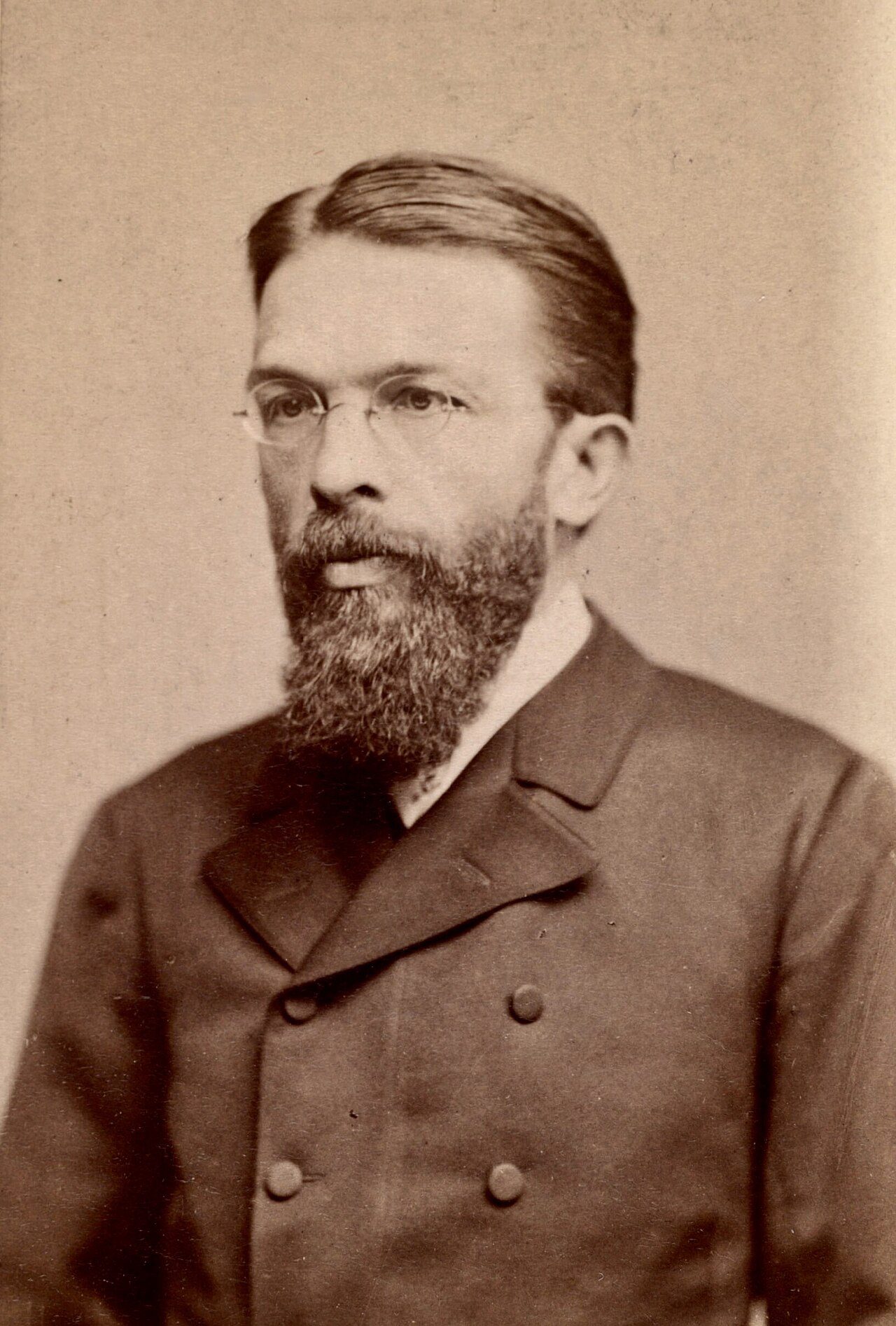
Twenty-one years earlier, the man who moved the Vienna bourse by talking about bimetallism had published a book that hardly anyone outside the German-speaking world could read, and that would wait seventy-nine years for an English edition. It is a slim book with no equations: in the whole of the standard English translation the equals sign does not appear once. Yet when first-year students are told today that the value of a thing is not in the thing, they are being taught Carl Menger, and this book is the reason.
Three numbers
A lawyer’s son in Galicia
He was born on 23 February 1840 at Neu-Sandez (Nowy Sącz) in Galicia, the Habsburg empire’s poor Polish north-east3. The date most often printed is wrong: Hayek’s 1934 memoir gives 28 February, and the error has spread ever since. Menger’s own son, working from family papers, has him born “around noon on February 23, 1840, in Nowy Sącz”4, and Wieser, in an obituary appreciation of 1923, notes that he died on 26 February 1921, “three days after he had reached the age of 81”5.
The family was comfortable and legally minded. His father, also called Anton, was a doctor of law and an advocate; his mother Caroline was the daughter of a Bohemian merchant who had made money speculating in colonial goods during the Napoleonic blockade1. Of ten children, six reached adulthood, three sons and three daughters4. The father died in 1848, when Carl was eight6.
Both of Carl’s brothers became well known, in different directions. Max was a Vienna advocate who sat in the Reichsrat from 1874 to 1907. Anton became professor of civil procedure at Vienna, rector of the university in 1895–96, and the author of Das Recht auf den vollen Arbeitsertrag, a book of non-Marxian socialism6. Carl’s son Karl summed up the family’s politics briskly: “Carl and Max were liberals and Anton a non-Marxian socialist”4.
The family held a minor untitled nobility, “von Wolfensgrün”, and gave it up. Carl’s father and uncles “agreed to renounce their hereditable untitled nobility and drop the suffix von Wolfensgrün from the family name”, as “convinced democrats”; Carl himself “was embarrassed whenever his nobility was mentioned”4. Much later, when Franz Joseph gave him the Order of the Iron Crown, third class, he wrote that he “bore it with a smile, since no one who has seen what sort of people wear first-class honors could feel honored by a third class order”4. He never used the knighthood that came with it.
He read law at Vienna from 1859 to 1860 and at Prague from 1860 to 1863, and took his doctorate in law at Kraków on 19 March 186734.
The newspapers
The story of how Menger found his subject is told everywhere. Wieser told it first, in the first person:
Menger once told me how he had come to find this solid foundation. As a young staff member for the Wiener Zeitung [Vienna Times] he had to write summaries on the state of the [commodity] markets. In preparing these reports, he came to realize that the facts to which the most knowledgeable experts attributed the greatest influence for explaining the formation of prices had little in common with the cost-theories taught by the Classical economists.5
The young journalist who notices that the traders and the textbooks disagree makes a wonderful story, and it should probably not be believed. Hayek, who repeated it, hedged at once: whether this “was really the original cause which led Menger to the study of the determination of prices or whether, which seems more likely, it only gave a definite direction to studies which he had been pursuing since he had left the university, we do not know”1. By 1968 Hayek was pointing instead at Menger’s heavily annotated copy of Rau’s textbook. Current scholarship is blunter. Working through Karl Menger’s unfinished biography of his father, Reinhard Schumacher and Scott Scheall report that “more recent research indicates that this story is an exaggeration, if not a fiction”, and that Ikeda, tracing how the book came about, called the tale of the market reports “a myth”4.
What is not a myth is that Menger was a working journalist of some consequence, with a much larger career than the anecdote suggests. As a student in Prague he wrote for the Tagesbote aus Böhmen. From 1863 he was a junior editor of the official Lemberger Zeitung in Lviv, until the paper went bankrupt the following year. He wrote for Der Botschafter and for Die Presse. In November 1865 he applied for a permit to found a paper of his own, was interviewed by the Minister-President, and launched the Wiener Tagblatt, intended as a “truly democratic paper for the masses”, which the government later took over. He then took charge of the economics section of the Wiener Zeitung, the official gazette, and left both papers in September 1866, ill and exhausted. In old age he told his son, with a smile and no apparent regret, that he could easily have become a millionaire had he stayed4.
By 1871 he was back at the official gazette. He resigned in protest at the Fundamentalartikel, the failed compromise with the Czech federalists, returned when the government fell, and moved into the press department of the Minister-President’s office4. For the better part of a decade, then, he was a political newspaperman. The book came out of that world, whether or not it came out of a market report.
The book
Grundsätze der Volkswirthschaftslehre was published in Vienna early in 1871 by Wilhelm Braumüller, the imperial and royal court and university bookseller. Its title page reads Erster, allgemeiner Theil (first, general part), and no second part ever appeared7. The dedication, in ornate type, offers the book “with respectful esteem” to Wilhelm Roscher, Royal Saxon Councillor and professor at Leipzig7. Roscher was a leader of the German Historical School and the author Menger cites most often in the book8. Twelve years later Menger would publish a frontal attack on that school’s entire method.
Menger’s preface is unembarrassed about the debt. The field he is treating, he writes, is “in no small degree so truly the product of recent development in German political economy”, and his reform of it “is therefore built upon a foundation laid by previous work that was produced almost entirely by the industry of German scholars”9. Modern scholarship has taken him at his word. Erich Streissler’s study of the German textbooks Menger read concludes that key ideas of the Principles were “foreshadowed” in them, that Menger “amply borrowed”, and that he was “no maverick” but saw himself as a perfecter of received German doctrine8. Streissler also drew a line: Menger’s overall approach, he judged, “has no recognizable forebears in German economics”8.
The book starts again from the ground up. It opens: “All things are subject to the law of cause and effect. This great principle knows no exception, and we would search in vain in the realm of experience for an example to the contrary”9. From there Menger asks what makes a thing a good at all. His answer is four conditions that must all hold at once: a human need; properties that make the thing able to satisfy it; human knowledge of that connection; and enough command of the thing to direct it to the need9.
The third condition is the interesting one. A mineral spring whose waters cure a disease is not a good until somebody knows that they do. Goods-character, Menger says in a footnote, “is nothing inherent in goods and not a property of goods, but merely a relationship between certain things and men, the things obviously ceasing to be goods with the disappearance of this relationship”9.
He then sorts goods by their distance from the need they serve. Bread is a good of the first order, flour of the second, the mill of the third. Dependence runs one way only: “The value of goods of lower order cannot, therefore, be determined by the value of the goods of higher order that were employed in their production. On the contrary, it is evident that the value of goods of higher order is always and without exception determined by the prospective value of the goods of lower order in whose production they serve”9. If nobody wants tobacco, the tobacco fields are worth nothing, and no amount of labour spent on them will change that. He is severe on the cost theories of value: it is, he writes, “among the most egregious of the fundamental errors” in the history of the subject to argue “that goods attain value for us because goods were employed in their production that had value to us”9.
And so to value itself, in the sentence that keeps his name alive: “Value is thus nothing inherent in goods, no property of them, nor an independent thing existing by itself. It is a judgment economizing men make about the importance of the goods at their disposal for the maintenance of their lives and well-being. Hence value does not exist outside the consciousness of men”9.
The table
To show how such judgments work, Menger drew a grid, the only apparatus in the book. He numbers the importance of satisfactions: those that life depends on get 10, the rest 9, 8, 7 and so on down to 1. He then notes that each satisfaction loses importance as it is repeated, so each column also runs down to nought. The result is ten columns of descending whole numbers, sixty-five cells, with Roman numerals across the top7.
Menger names only two of the ten columns: column I is food, column V tobacco. The point of the grid is what a person does with it: “if his need for food is already satisfied up to a certain degree of completeness (if, for example, a further satisfaction of his need for food has only the importance to him that we designated numerically by the figure 6), consumption of tobacco begins to have the same importance to him as further satisfaction of his need for food”9. You eat until the next mouthful is worth six, and at six you light a pipe instead.
It is the marginal principle, drawn as a staircase, with no derivative in sight.
The only apparatus in the book
Menger’s value table, Grundsätze der Volkswirthschaftslehre (1871), p. 93. Ten kinds of need; the importance of each further unit consumed.
The table as Menger printed it
| column | I | II | III | IV | V | VI | VII | VIII | IX | X |
|---|---|---|---|---|---|---|---|---|---|---|
| unit 1 | 10 | 9 | 8 | 7 | 6 | 5 | 4 | 3 | 2 | 1 |
| unit 2 | 9 | 8 | 7 | 6 | 5 | 4 | 3 | 2 | 1 | 0 |
| unit 3 | 8 | 7 | 6 | 5 | 4 | 3 | 2 | 1 | 0 | |
| unit 4 | 7 | 6 | 5 | 4 | 3 | 2 | 1 | 0 | ||
| unit 5 | 6 | 5 | 4 | 3 | 2 | 1 | 0 | |||
| unit 6 | 5 | 4 | 3 | 2 | 1 | 0 | ||||
| unit 7 | 4 | 3 | 2 | 1 | 0 | |||||
| unit 8 | 3 | 2 | 1 | 0 | ||||||
| unit 9 | 2 | 1 | 0 | |||||||
| unit 10 | 1 | 0 | ||||||||
| unit 11 | 0 |
The table also shows what Menger was not doing. There is no maximisation here, no equilibrium and no calculus. The numbers are ranks, chosen, as he says himself, “merely to facilitate demonstration of a difficult and previously unexplored field of psychology”9. William Jaffé, comparing him with the two men who published the same insight at the same time, put the difference memorably: Menger’s man, unlike the “lightning calculator” of the mathematical economists, “is a bumbling, erring, ill-informed creature, plagued with uncertainty, forever hovering between alluring hopes and haunting fears, and congenitally incapable of making finely calibrated decisions in pursuit of satisfactions”. Hence, Jaffé wrote, “Menger’s scales of the declining importance of satisfactions are represented by discrete integers. In Menger’s scheme of thought, positive first derivatives and negative second derivatives of utility with respect to quantity had no place; nothing is differentiable”10.
It was a choice. In Jaffé’s words, “Carl Menger avoided the use of mathematics in his economics not because he did not know any better, but out of principle”10. Hayek, who went looking for Menger’s views on mathematical economics and found almost nothing, noted the silence with some puzzlement: “There is no reason to assume that he lacked either the technical equipment or the inclination”1.
The chair
The book was meant to win him a university post, and very nearly failed to. He applied to habilitate in February 1871, before it had even gone to the publisher. Lorenz von Stein obstructed him, and his first trial lecture was rejected. A second, in May 1872, succeeded, and the faculty granted him the right to teach the following month. His mother died in the middle of it all4.
Whether the book was received coldly is disputed. Hayek thought so: “None of the reviewers in the German journals seem to have realised the nature of its main contribution”1. A recent bibliographical survey flatly disagrees. It counts thirteen reviews and notices between 1871 and 1874 and concludes that “it was neither ignored nor disregarded at the time of its publication, as some narratives suggest”11. One of those reviewers was Gustav Schmoller. In 1873 he called the book a set of “astute investigations of some of the basic concepts of political economy” and complained that its direction was “too one-sided for a textbook”. He also remarked, in a phrase that reads very differently a decade later, that “his strength lies in the abstract, detailed consideration of simple processes; he loves mathematical forms and formulas”12.
Menger became extraordinary professor in autumn 1873 and full professor of political economy at Vienna in February 1879, having declined calls to Karlsruhe, Basel and the Zurich Polytechnic31. An American visitor, Henry Seager, sat in on his lectures in 1892 and described a man at the height of his powers: “In lecturing he rarely uses his notes except to verify a quotation or a date.” He also wrote: “It is said that those who attend Professor Menger’s lectures regularly need no other preparation for their final examination in political economy, and I can readily believe it”13.
The Crown Prince
In 1876 Menger was appointed one of the tutors of Crown Prince Rudolf, then eighteen, and spent the next two years travelling with him through England, Scotland, Ireland, France and Germany1. The itinerary, as Karl Menger recorded it, is a period piece: clubs and balls in London, dinner with the Empress Elisabeth, the British Museum, the Bank of England and Quaritch’s antiquarian bookshop (both men were bibliophiles); Scotland and Ireland in January; Paris and a dinner with President MacMahon; Berlin in March 1878, dinner with Wilhelm I and an introduction to Bismarck4.
The lectures Menger gave him survive and were published in 1994 by Erich and Monika Streissler14. They are emphatic. Government, Menger told the heir to the throne, “cannot possibly know the interests of all citizens, and in order to help them it would have to take account of each of the diverse activities of everybody”; under socialism “a despotic system would develop … Nobody could choose his vocation or profession, but would have to comply with government regulations in all matters”15.
How far this reflects Menger’s own convictions is contested. The editors called the notes “probably one of the most extreme statements of the principles of laissez-faire ever put to paper”, yet elsewhere in the same volume Menger dismissed as frivolous the charge that he belonged to the Manchester School16. Streissler himself, in a separate article, read Menger as a supporter of state intervention; a survey of the literature finds assessments ranging from Menger the “champion of laissez-faire” to Menger the interventionist to Menger the man who did not much care about economic policy at all17. Menger’s granddaughter Eve, who placed the family papers at Duke, has objected in print that the editors infer her grandfather’s beliefs from what he left out of an introductory course, and that “judging what a teacher believes to be important from what he or she teaches in an introductory class is a fraught methodology”, adding that the Emperor himself sometimes dropped in16.
The pamphlet, at least, is not in doubt. In the last months of 1877 Menger and Rudolf wrote an attack on the Austrian higher aristocracy and its failure to play a constitutional role, which they published anonymously the following year. According to Karl Menger, the sharpest denunciations were Rudolf’s, while his father stressed the importance of a nobility to a conservative party4. The authorship came to light only in 1906, seventeen years after Rudolf shot his mistress and himself at Mayerling1. The two men had corresponded to the end; the last letter from Rudolf is dated 3 December 18884. The day after Rudolf’s death, Menger published an anonymous obituary of his former pupil in the press18.
The war with Schmoller
In 1883 Menger published Untersuchungen über die Methode der Socialwissenschaften, a defence of theory itself against a German profession that had decided economics was a branch of history. Its most lasting passage is not polemical at all. Some social institutions, Menger observes, are made on purpose, by agreement or legislation. Others are not, and those are the puzzle:
Language, religion, law, even the state itself, and, to mention a few economic social phenomena, the phenomena of markets, of competition, of money, and numerous other social structures are already met with in epochs of history where we cannot properly speak of a purposeful activity of the community as such directed at establishing them.19
Hence his question, which has kept social scientists busy ever since: “How can it be that institutions which serve the common welfare and are extremely significant for its development come into being without a common will directed toward establishing them?”19 Such things, he says, are “the unintended result of individual human efforts”19.
Schmoller reviewed the book in his own journal and did not hold back. He began by admitting his personal stake (“Only in Menger’s case I cannot completely restrain the polemics, since some of his attacks also affect me personally”) and ended with a verdict that is still quoted as a model of the form:
Menger is a penetrating dialectician, a logical mind, an extraordinary scholar, but he lacks the universal-philosophical and historical education as well as the natural breadth of horizon which is able to accommodate experiences and ideas from all sides. … But his impact will certainly not be that of a reformer. Rather, he is an epigone.20
He closed the section: “We are done with the book”20.
Menger replied in 1884 with Die Irrthümer des Historismus in der deutschen Nationalökonomie, sixteen letters to a friend. Schmoller’s answer is the most extraordinary document in the whole affair, and he printed it himself. The editorial office of the yearbook, he announced, was in no position to report on the book, since it had immediately returned it to the author with the following lines. He then reprinted the covering letter:
I throw all such personal attacks, especially if I do not expect any further new promotion for myself from the respective author, unread into the oven or into the dust bin. … I do not want to be rude to you to destroy such a beautifully designed booklet by your hand; I therefore send it back to you enclosed with sincere thanks and the request to make a better use of it elsewhere. Incidentally, I will always remain grateful to you for further attacks. Because: ‘many enemies, much honor’.21
Hayek called it “probably unprecedented”1. It also worked. Schmoller had considerable influence over appointments in the German universities: most chairs in political economy were filled on his recommendation, and he worked closely with Friedrich Althoff, who ran the Prussian academic system22. Hayek’s own account goes further. He claims that Schmoller “went so far as to declare publicly that members of the ‘abstract’ school were unfit to fill a teaching position in a German university”, but gives no source for it, and the specific claim has proved hard to verify1.
Schumpeter, looking back from 1954, thought the whole thing a waste: “the history of this literature is substantially a history of wasted energies, which could have been put to better use”, the more so because “neither party really did question its opponent’s position outright”23. Not everyone agrees: the book’s English editor thought that judgment “too sweeping and too harsh, simply on the evidence of the Untersuchungen”19. The cost in time is clear. Menger was forty-three when the Untersuchungen appeared and forty-four when he answered Schmoller, and the second part of the Grundsätze was never written.
1892
Then came an extraordinary year. In 1892 Menger published the article “Geld” in the Handwörterbuch der Staatswissenschaften, which Hayek ranked as the third and last of his major contributions to theory; two pamphlets on the Austrian currency question; and a short paper in the London Economic Journal, translated by C. A. Foley, called “On the Origin of Money”124.
The paper begins with an oddity. Everybody accepts gold and silver, and later paper representing them, in exchange for real goods. Why? “That every economic unit in a nation should be ready to exchange his goods for little metal disks apparently useless as such, or for documents representing the latter, is a procedure so opposed to the ordinary course of things, that we cannot well wonder if even a distinguished thinker like Savigny finds it downright ‘mysterious’”24.
The usual answer was that money had been agreed on, or decreed. Menger did not believe it, and his objection is historical: an act of such importance, repeated in a great many places, would have left a record, and none exists. What he proposes instead rests on a property of goods he calls Absatzfähigkeit, which Foley renders as saleableness: “A commodity is more or less saleable according as we are able, with more or less prospect of success, to dispose of it at prices corresponding to the general economic situation, at economic prices”24. Some goods have a great deal of it and some almost none, and the difference lies in markets rather than taste: how many people want the thing, over how wide an area, in what quantities, and how long it keeps.
The argument then turns on one step. A man who cannot find anyone who wants exactly what he has will do better to trade it for something more saleable, even if he has no use for it himself, and try again. Everyone who notices this does the same. And so:
Men have been led, with increasing knowledge of their individual interests, each by his own economic interests, without convention, without legal compulsion, nay, even without any regard to the common interest, to exchange goods destined for exchange (their “wares”) for other goods equally destined for exchange, but more saleable.24
Money is what is left at the end of that process. “Money has not been generated by law. In its origin it is a social, and not a state institution”24. Menger does not overstate the case: state recognition and regulation have “perfected” money and adjusted it to the needs of commerce, as statute law has perfected customary right; they have “not first made money of the precious metals”24.
The commission this story began with sat in March of the same year. On whether to adopt gold it largely agreed; Menger, as its leading member, argued about the exact parity and the right moment to change1. The crown came in that August, though the gulden remained legal tender beside it until the end of 18992.
Hermine and Karl
Around 1888 Menger, then approaching fifty, met Hermine Andermann, a nineteen-year-old writer and musician from Stanislau in Galicia. They lived together until his death in 1921 and never married25. Their son Karl was born in Vienna on 13 January 190226.
The usual explanation for their thirty-three unmarried years is that Andermann was Jewish and Menger Catholic. The scholars who worked through the family papers say directly that this is not true: mixed couples in Austria could contract an “emergency civil marriage” after 1868, and in any case Andermann left the Jewish faith in 1893 and, according to her son’s baptismal record, converted to Catholicism the same year25. Why they did not marry is not known. One possibility the same authors raise is that Menger had argued as a young man that marriage was obsolete and that civil society would in future be based on free love25.
The arrangement had costs, and they fell on the child. In his early years Karl lived alone with his mother while his father lived nearby; the family moved in together only around 1912 or 1913. He was legitimated in April 1911 by direct appeal to the Emperor, and until then was legally Karl Andermann-Menger; his mother kept the name Andermann until August 1921, after Carl’s death25. The boy grew up to be a very considerable mathematician: dimension theory, the Vienna Circle, a long career in Chicago26.
Karl’s account of his parents is affectionate and clear-eyed: his mother “apparently took the decision early on to dedicate her life to her admired scholar”, read aloud to him as his eyesight failed, nursed him when he was ill, and ran the household in his last decade25.
In 1903, the year after his son was born, Menger resigned his chair, aged sixty-three. Three reasons are offered, and they do not exclude one another. Hayek’s, the one usually repeated, is that he did it “in order to be able to devote himself entirely to his work”1. A second, which appears on English Wikipedia, blames pessimism about German scholarship; it carries no citation, and we could not trace it to any source. The third is social. A professor in Franz Joseph’s Vienna with an unmarried partner and an illegitimate child was in an awkward position, and the specialists who know the papers best put it carefully: his son’s birth “marked the beginning of Carl’s gradual retreat from Viennese society and academic life in particular”, whether from that controversy, fatigue, ill health or the wish for time to write25. The chair went to Friedrich von Wieser. Menger had been made a life member of the upper house in 1900 and made little use of it: “he did not care sufficiently to take a very active part in its deliberations”, Hayek wrote. “To him the world was a subject for study much more than for action”1.
The silence
A working life
Major works have the larger dots, everything else the smaller ones. The band covers the years after the last of them.
The dates
| year | event | major work |
|---|---|---|
| 1840 | born at Neu-Sandez (Nowy Sącz), Galicia, 23 February | |
| 1867 | doctorate in law, Kraków, 19 March | |
| 1871 | Grundsätze der Volkswirthschaftslehre | yes |
| 1876–78 | tutor to Crown Prince Rudolf | |
| 1879 | full professor at Vienna (February) | |
| 1883 | Untersuchungen über die Methode der Socialwissenschaften | yes |
| 1884 | Die Irrthümer des Historismus | yes |
| 1892 | “Geld”; “On the Origin of Money”; two currency pamphlets; the currency commission | yes |
| 1902 | son Karl born, 13 January | |
| 1903 | resigns the chair, aged 63 | |
| 1914 | last published article, an obituary of Böhm-Bawerk | |
| 1921 | dies in Vienna, 26 February, aged 81 |
He lived for another eighteen years after leaving the university and published almost nothing. Hayek’s summary is stark: after 1892 “he only published occasional small articles”, mostly reviews, biographical notes and introductions to work by his pupils, and “his last published article is an obituary of his disciple Böhm-Bawerk, who died in 1914”1.
The great book kept growing and never appeared. Menger’s reading spread ever wider, into philosophy, psychology and ethnography, and the work was “again and again postponed”. Parts of it were at one time ready for the press; then he revised and rearranged until reconstruction became, in Hayek’s judgment, “a very difficult, if not an impossible task”. Hayek sums up the whole project in one sentence: “For the present, at any rate, the results of the work of Menger’s later years must be regarded as lost”1.
All this time he was also buying books. By 1911 he put his own library at something like 25,000 volumes27. After his death the social science and anthropology sections were sold to the Commercial University of Tokyo, now Hitotsubashi, which acquired them in 1922; the collection there runs to about 19,100 volumes on economics, politics, law, history, ethnography and travel2829. It includes a first edition of the first volume of Capital, Menger’s annotated Rau and Roscher, and his own interleaved copy of the Grundsätze, on which he had rewritten the title by hand as Allgemeine theoretische Wirthschaftslehre29.
That last detail had a sad consequence. Menger’s son spent the years from December 1918 assembling a second edition from his father’s papers, hoping to present it on the old man’s eightieth birthday; it appeared in 1923, two years after his father’s death, from Hölder-Pichler-Tempsky25. He had to work without the most heavily annotated copy his father owned, because it had already been sold and shipped. As Hitotsubashi’s own library puts it, “he could not refer to his father’s special book because it had already been purchased by the Hitotsubashi University and brought to Japan”28.
Scholars have mostly gone on citing the 1871 edition. Menger’s English translators explained why they had used it: it was “the first edition only that influenced the development of economic doctrine”, and the second was posthumous9. Hayek, editing the collected works for the London School of Economics in the 1930s, also reprinted the first edition. But the second edition has its defenders, and to dismiss it as a botched job is too quick: it introduces social needs and common goods, Karl Polanyi read it as a herald of economic anthropology, and a live literature treats it as a substantively different book rather than a worse one30.
Menger died in Vienna on 26 February 1921, aged eighty-one. His granddaughter gave his papers to Duke University in 198731.
What survived
The odd thing about Menger’s afterlife is how much of it happened without his name attached.
Value is thus nothing inherent in goods, no property of them, nor an independent thing existing by itself. It is a judgment economizing men make about the importance of the goods at their disposal for the maintenance of their lives and well-being.
The subjective theory of value simply won. What was once a school of thought is now the first week of the course. A current American textbook introduces marginal utility as the additional satisfaction from one more unit, notes that it diminishes, and cautions that utils cannot be compared between people because they are “subjective to an individual”32. Menger’s table, his diminishing columns and his insistence that value lives in the consciousness of men are taught to eighteen-year-olds as plumbing.
The book itself, though, was very hard to get at. Jevons, publishing in the same year, wrote in English and needed no translator. Menger waited seventy-nine years: the Grundsätze appeared as Principles of Economics, translated by James Dingwall and Bert Hoselitz, only in 19509. The Untersuchungen of 1883 waited eighty, until 196319. Part of the delay was his own doing: Hayek records that the book had gone out of print and that “Menger refused to permit either a reprint or a translation”1. When the translators finally did the job, they called the gap “a mystery” and observed that English-speaking economists, “relying upon second-hand expositions of Menger’s ideas”, had “failed to obtain the full benefit of his innovations”9.
Eighty years out of reach
How long each founding text of the marginal revolution waited before an English-speaking economist could read it.
The dates
| work | first published | first English edition | years |
|---|---|---|---|
| Menger, Untersuchungen über die Methode | 1883 | 1963, as Problems of Economics and Sociology | 80 |
| Walras, Éléments d’économie politique pure | 1874 | 1954, trans. William Jaffé | 80 |
| Menger, Grundsätze der Volkswirthschaftslehre | 1871 | 1950, trans. Dingwall and Hoselitz | 79 |
| Menger, “On the Origin of Money” | 1892 | 1892, Economic Journal, trans. C. A. Foley | 0 |
| Jevons, The Theory of Political Economy | 1871 | 1871; written in English | 0 |
The record shows the consequences. Alfred Marshall’s Principles mentions Menger four times, three of them in passing, and engages with him analytically exactly once: in a footnote mocking the orders of goods, on the ground that a pleasure train carrying biscuits and milling machinery would be a good of the first, second, third and fourth orders at the same time33. George Stigler, who admired him, opened his 1941 chapter by noting that Menger “has been in Anglo-Saxon countries a famous but seldom-read economist” and calling it “a serious injustice”34. A citation study of post-war value theory found Walras third behind Hicks and Samuelson, “with Menger and Jevons nowhere in the running”35. Even Hayek left him out of his Nobel lecture of December 1974, the Austrian tradition’s moment of public vindication: neither the lecture nor the banquet speech names Menger at all, and the only economist Hayek invokes is Marshall36.
Yet the part of Menger that looked least like modern economics is the part that came back. From the late 1980s a literature grew up that asked exactly his question (why would anyone accept a useless token?) and answered it his way, building up from individuals who trade with whoever they happen to meet. Nobuhiro Kiyotaki and Randall Wright’s 1989 paper in the Journal of Political Economy made money an equilibrium outcome rather than an assumption, and it has been cited on the order of fifteen hundred times37. Writing up the approach for a general audience, the two named both the debt and their translation of his term in the same breath: “In addition to these intrinsic properties, Menger (1892) also emphasized what he called ‘saleability,’ or what we call acceptability. We define the acceptability of an object here to be the probability that it is accepted in exchange by other agents at a given price”38. Menger’s word for how easily a thing can be sold had become a number between nought and one.
The literature itself now routinely draws the line back to Menger. Reviewing the field, Stephen Williamson and Wright write that frictions like those in their models “have long been thought to be important for understanding the role of money, by such luminaries as Jevons (1875), Menger (1892), and Wicksell (1911)”, and that the aim of the search-based literature is “to formalize these ideas”39. Two historians of thought describe twentieth-century monetary theory as moving “from a neo-walrasian to a neo-mengerian framework”40.
They also record what did not make the journey: the half Menger cared about most. The equilibrium in which a good becomes money was absorbed; the evolutionary process by which it gets there was not. “Strategic interactions and essentiality are significant characteristics of the Mengerian approach to money and the search theoretical models nowadays,” they write. “Nevertheless, the evolutionary process Menger describes has not been fully integrated within modern search monetary theory”40.
Menger might have enjoyed the irony, or perhaps not. The economist who declined on principle to write down an equation was eventually proved right by a literature that consists of almost nothing else. One suspects he would have minded less than his followers do. In the Principles he had already said what his numbers were for: they were chosen merely to demonstrate something difficult and previously unexplored, in a field he regarded as psychology9. The apparatus was only ever a tool. His point was that the value of a thing lies not in the thing but in a judgment somebody makes, in a particular place, at a particular time, knowing what they happen to know. Everything else, including the mathematics he would not write, follows from that.
Sources
-
F. A. von Hayek, “Carl Menger”, Economica, new series 1(4), November 1934, pp. 393–420. Quoted throughout from the reprint as the introduction to the Dingwall and Hoselitz translation of the Principles; page numbers are those of that reprint. ↩︎ ↩︎ ↩︎ ↩︎ ↩︎ ↩︎ ↩︎ ↩︎ ↩︎ ↩︎ ↩︎ ↩︎ ↩︎ ↩︎ ↩︎ ↩︎ ↩︎
-
Oesterreichische Nationalbank, Österreichische Geldgeschichte, Vienna, on the law of 2 August 1892, the crown’s validity from 11 August 1892 to 31 December 1924, and the gulden’s until 31 December 1899, pp. 74, 76, 105–106. ↩︎ ↩︎
-
Erich W. Streissler, “Menger, Carl”, Neue Deutsche Biographie 17 (1994), pp. 72–74. ↩︎ ↩︎ ↩︎
-
Reinhard Schumacher and Scott Scheall, “Karl Menger’s Unfinished Biography of His Father: New Insights into Carl Menger’s Life through 1889”, CHOPE working paper 2020-01, Duke University; published in Research in the History of Economic Thought and Methodology 38B (2020), pp. 155–189. ↩︎ ↩︎ ↩︎ ↩︎ ↩︎ ↩︎ ↩︎ ↩︎ ↩︎ ↩︎ ↩︎ ↩︎ ↩︎
-
Friedrich von Wieser, “Carl Menger: A Biographical Appreciation”, first published in Neue Österreichische Biographie vol. 2, 1923; translated by Richard Ebeling, American Institute for Economic Research, 2019. Translation from German. ↩︎ ↩︎
-
Erich W. Streissler, “Menger, Anton”, Neue Deutsche Biographie 17 (1994), on the family, the father Anton Menger von Wolfensgrün and the brothers. ↩︎ ↩︎
-
Carl Menger, Grundsätze der Volkswirthschaftslehre. Erster, allgemeiner Theil, Vienna: Wilhelm Braumüller, 1871. Title page, dedication leaf, and the value table at p. 93. ↩︎ ↩︎ ↩︎
-
Daniel A. Harper and Anthony M. Endres, “Menger’s precursors in the German subjective-value tradition and his advancements in the theory of wants and goods”, Review of Austrian Economics 36 (2023), pp. 217–245. The quoted phrases of Erich Streissler are taken from this article, which cites his “The Influence of German Economics on the Work of Menger and Marshall”, in Bruce Caldwell (ed.), Carl Menger and His Legacy in Economics, Duke University Press, 1990, pp. 31–68, at pp. 32, 33, 44 and 61. ↩︎ ↩︎ ↩︎
-
Carl Menger, Principles of Economics, translated by James Dingwall and Bert F. Hoselitz, Glencoe, Ill.: Free Press, 1950; cited from the Mises Institute reprint, which carries Hayek’s introduction and the translators’ preface. Author’s preface p. 49; ch. I pp. 51–52; orders of goods pp. 63–65; value pp. 115–121; the table pp. 125–128; higher-order goods pp. 149–150; translators’ preface p. 38. Translation from German. ↩︎ ↩︎ ↩︎ ↩︎ ↩︎ ↩︎ ↩︎ ↩︎ ↩︎ ↩︎ ↩︎ ↩︎ ↩︎
-
William Jaffé, “Menger, Jevons and Walras De-Homogenized”, Economic Inquiry 14(4), December 1976, pp. 511–524, at p. 521. ↩︎ ↩︎
-
Federico Salazar, “The Early Reception of Carl Menger’s Grundsätze: A Bibliographical Note”, Journal of Contextual Economics — Schmollers Jahrbuch 141 (2021), pp. 343–362, at p. 344. ↩︎
-
Gustav Schmoller, review of Menger’s Grundsätze, Literarisches Centralblatt für Deutschland, No. 5, 1 February 1873, cols. 142–143; English translation in Journal of Contextual Economics 141 (2021), pp. 321–322. Translation from German. ↩︎
-
Henry R. Seager, “Economics at Berlin and Vienna”, Journal of Political Economy 1(2), March 1893, pp. 236–262. ↩︎
-
Erich W. Streissler and Monika Streissler (eds), Carl Menger’s Lectures to Crown Prince Rudolf of Austria, translated by Monika Streissler and David F. Good, Aldershot: Edward Elgar, 1994. ↩︎
-
Richard M. Ebeling, “Carl Menger and the Sesquicentennial Founding of the Austrian School”, American Institute for Economic Research, 2019, quoting the Streissler translation of the lectures to Crown Prince Rudolf. Translation from German. ↩︎
-
Eve Menger, “Letter to the Editors: Some thoughts on Carl Menger’s Lectures to Crown Prince Rudolf”, Journal of the History of Economic Thought 47(1), 2024, pp. 116–118. ↩︎ ↩︎
-
Giandomenica Becchio, “Introduction: Carl Menger and Classical Liberalism”, Cosmos + Taxis 10(5+6), 2022, pp. 1–6, surveying the range of readings of Menger’s politics. ↩︎
-
Raimondo Cubeddu and Marco Menon, “Carl Menger, a Public Engaged Intellectual, and Five Translations of His Newspaper Articles”, Cosmos + Taxis 10(5+6), 2022, pp. 7–23, at p. 7, on the anonymous obituary of Crown Prince Rudolf published the day after Mayerling. ↩︎
-
Carl Menger, Investigations into the Method of the Social Sciences with Special Reference to Economics, translated by Francis J. Nock, edited by Louis Schneider, New York University Press, 1985; first published as Untersuchungen über die Methode der Socialwissenschaften und der politischen Oekonomie insbesondere, Leipzig: Duncker & Humblot, 1883, and first translated in 1963 as Problems of Economics and Sociology. Quoted at pp. 133, 146 and 147; Schneider’s dissent from Schumpeter at p. 13 of his introduction. Translation from German. ↩︎ ↩︎ ↩︎ ↩︎ ↩︎
-
Gustav Schmoller, “Zur Methodologie der Staats- und Sozialwissenschaften”, Jahrbuch für Gesetzgebung, Verwaltung und Volkswirthschaft im Deutschen Reich 7(3), 1883, pp. 975–994; English translation in Journal of Contextual Economics 141 (2021), pp. 323–340, at pp. 323 and 334. Translation from German. ↩︎ ↩︎
-
Gustav Schmoller, notice returning Menger’s Die Irrthümer des Historismus, Jahrbuch für Gesetzgebung, Verwaltung und Volkswirthschaft im Deutschen Reich 8(2), 1884, p. 677; English translation in Journal of Contextual Economics 141 (2021), pp. 341–342. Translation from German. ↩︎
-
Karen Horn and Stefan Kolev, “Dispute on Method or Dispute on Institutional Context? Foreword to the Translation of Carl Menger’s ‘Errors of Historicism’”, Econ Journal Watch 17(2), September 2020, pp. 442–507, at p. 444, on Schmoller’s influence over appointments and his cooperation with Friedrich Althoff. ↩︎
-
Joseph A. Schumpeter, History of Economic Analysis, New York: Oxford University Press, 1954, p. 814. ↩︎
-
Carl Menger, “On the Origin of Money”, translated by C. A. Foley, The Economic Journal 2(6), June 1892, pp. 239–255. Quoted from the Mises Institute edition, at its pp. 11, 26–27, 34 and 51 (sections I, IV, VI and IX). Translation from German. ↩︎ ↩︎ ↩︎ ↩︎ ↩︎ ↩︎
-
Scott Scheall and Reinhard Schumacher, “Karl Menger as Son of Carl Menger”, CHOPE working paper; published in History of Political Economy 50(4), 2018, pp. 649–678. ↩︎ ↩︎ ↩︎ ↩︎ ↩︎ ↩︎ ↩︎
-
Seymour Kass, “Karl Menger”, Notices of the American Mathematical Society 43(5), 1996, pp. 558–561. ↩︎ ↩︎
-
F. A. von Hayek, “Menger, Carl”, International Encyclopedia of the Social Sciences, 1968, on the library and on the sale of its social science sections to Tokyo. ↩︎
-
Hitotsubashi University Library, “The Digital Library of the Carl Menger Collection”, on the 1922 acquisition, the approximately 19,100 volumes, and the annotated copy already shipped to Japan when the second edition was edited. Retrieved 23 September 2026. ↩︎ ↩︎
-
Hitotsubashi University, Center for Historical Social Science Literature, “The Carl Menger Collection”, on the contents of the library. Retrieved 23 September 2026. ↩︎ ↩︎
-
Giandomenica Becchio, “Social Needs, Social Goods, and Human Associations in the Second Edition of Carl Menger’s Principles”, History of Political Economy 46(2), 2014, pp. 247–264. ↩︎
-
David M. Rubenstein Rare Book & Manuscript Library, Carl Menger Papers, 1857–1985, Duke University. Ten linear feet, about 7,500 items, donated in 1987 by Eve L. Menger. ↩︎
-
OpenStax, Principles of Economics 3e, §6.1, “Consumption Choices”. Retrieved 23 September 2026. ↩︎
-
Alfred Marshall, Principles of Economics, 5th edition, London: Macmillan, 1907, book II ch. III §1, footnote 3. ↩︎
-
George J. Stigler, Production and Distribution Theories: The Formative Period, New York: Macmillan, 1941, ch. VI, at p. 134. ↩︎
-
George J. Stigler and Claire Friedland, “The Citation Practices of Doctorates in Economics”, Journal of Political Economy 83(3), 1975, pp. 477–507, as reported by Jaffé 1976, p. 523 n. 61. ↩︎
-
F. A. Hayek, “The Pretence of Knowledge”, lecture to the memory of Alfred Nobel, 11 December 1974. Own check of the lecture and of the banquet speech of 10 December 1974: neither mentions Menger. ↩︎
-
Nobuhiro Kiyotaki and Randall Wright, “On Money as a Medium of Exchange”, Journal of Political Economy 97(4), August 1989, pp. 927–954. Citation counts retrieved 23 September 2026: 1,433 in OpenAlex, 855 in Crossref, 2,251 in Google Scholar. ↩︎
-
Nobuhiro Kiyotaki and Randall Wright, “Acceptability, Means of Payment, and Media of Exchange”, Federal Reserve Bank of Minneapolis Quarterly Review 16(3), 1992, pp. 18–19. ↩︎
-
Stephen Williamson and Randall Wright, “New Monetarist Economics: Methods”, Federal Reserve Bank of Minneapolis staff report 442, April 2010, pp. 19–20. ↩︎
-
Andrés Álvarez and Vincent Bignon, “L. Walras and C. Menger: two ways on the path of modern monetary theory”, European Journal of the History of Economic Thought 20(1), 2013, pp. 89–124, DOI 10.1080/09672567.2011.596939. Quoted from the EconomiX working paper 2010-25, September 2010, at pp. 14 and 18. ↩︎ ↩︎

.jpg)


.jpg)